“Of course” and “ofcourse” look almost identical, but only one belongs in proper English. I broke down the grammar, the confusion, and the correct way to use this everyday phrase.
If you’ve ever paused mid-sentence wondering whether to type one word or two, you’re not alone. This phrase is one of the most commonly used expressions in English, which also makes it one of the most commonly misspelled. Below, I’ll walk through exactly why “of course” is correct, why “ofcourse” keeps showing up anyway, and how to use the phrase confidently in any writing situation.
Quick Answer
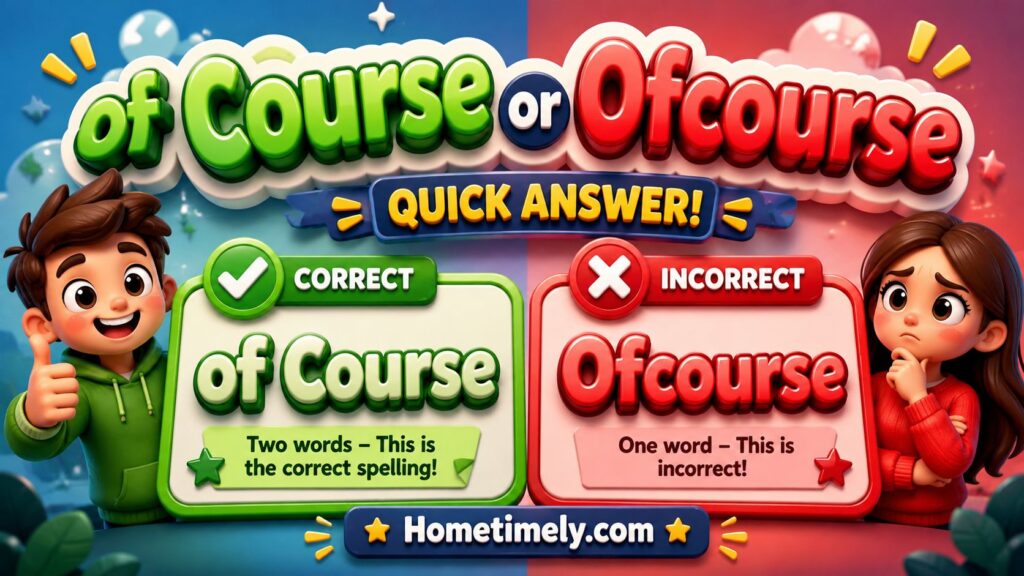
Here’s the short version: “of course” is always written as two separate words. “Ofcourse” is not a recognized word in standard English in any variety, whether American, British, Australian, or Canadian.
| Question | Answer |
| Correct spelling | Of course (two words) |
| Is “ofcourse” correct? | No, it’s a common misspelling |
| Part of speech | Adverbial phrase |
| Meaning | Certainly, naturally, obviously |
| Used in formal writing? | Yes |
| Used in casual speech? | Yes |
| Recognized by dictionaries? | Only “of course” |
No English dictionary not Merriam-Webster, not Cambridge, not Oxford lists “ofcourse” as a valid entry. It’s purely a spacing error, and one that’s easy to fix once you understand why it happens.
What Does “Of Course” Mean in English?
“Of course” is an adverbial phrase used to express certainty, agreement, or something that’s obvious or expected. It signals that whatever comes next shouldn’t be surprising it’s the natural, expected answer or outcome.
You’ll typically see it used in a few core ways:
- To agree with someone: “Can you help me move this weekend?” “Of course!”
- To confirm something obvious: “Of course water boils faster at higher temperatures near sea level.”
- To grant permission: “Can I borrow your charger?” “Of course, go ahead.”
- To add emphasis or acknowledgment mid-sentence: “The plan, of course, depends on the weather.”
The phrase carries a tone of confidence and reassurance. It tells the listener or reader that there’s no doubt, no hesitation, and nothing unusual about the statement being made.
Historically, “of course” comes from the idea of a “course” as a natural path or progression — the same root sense found in phrases like “the course of history” or “in due course.” Something that happens “of course” is something that follows the expected, natural path of events. Over centuries of use, that literal sense faded into the more general meaning we use today: certainty, obviousness, or agreement.
It’s also worth noting that “of course” carries slightly different weight depending on where it sits in a sentence. At the start of a sentence, it often signals warmth or willingness. In the middle, set off by commas, it usually adds a light emphasis or acknowledgment. At the end, it often reinforces or confirms what was just said. Recognizing these subtle shifts helps you place the phrase more naturally in your own writing.
Is “Ofcourse” a Word in English?
No. “Ofcourse” is not a recognized word in any standard English dictionary. It’s a nonstandard spelling — essentially a typo that has become common enough to look deceptively normal.
Here’s why it doesn’t hold up grammatically:
- “Of” is a preposition. It functions independently and never merges with the word that follows it in this phrase.
- “Course” is a noun. In this context, it refers to a path, direction, or natural progression as in “the course of events.”
- Together, they form a fixed two-word phrase, similar to other prepositional expressions like “in fact,” “at last,” or “by chance.” None of those combine into single words either, and neither does this one.
Unlike words such as “notebook” or “sunflower,” which started as two words and eventually merged through common usage, “of course” has never gone through that transition. It has remained two words for centuries, and every major style guide and dictionary confirms that.
Compare this to genuine compound words that did merge over time. “Note” and “book” combined because the two nouns together formed a new, distinct concept a bound object for writing notes. “Of” and “course,” on the other hand, don’t create a new noun or concept when combined. They function together as a grammatical unit, similar to how “in fact” or “at once” work. Prepositional phrases like these almost never merge into single words in English, and “of course” is no exception to that pattern.
If you check any major English dictionary — Merriam-Webster, Cambridge, Oxford, or Collins — you’ll find “of course” listed as an entry, always spelled as two words. None of them list “ofcourse” as an accepted alternate spelling, informal variant, or regional form. That consistency across every major reference source is about as strong a confirmation as you’ll get in English grammar.
Why People Confuse “Of Course” and “Ofcourse”
This mix-up isn’t random. A few clear patterns explain why so many writers including fluent English speakers accidentally merge the two words.
- Pronunciation blending: When spoken quickly, “of course” often sounds like a single unit — something closer to “uh-course” or “of-course” run together. Your ear hears one sound, but the written form still requires two words.
- Pattern matching with real compound words: English does have plenty of legitimate compound words — “notebook,” “fireplace,” “background.” It’s natural to assume “of course” might follow the same pattern, even though it doesn’t.
- Fast typing and autocorrect gaps: Many people type quickly without double-checking spacing, and not every spellchecker catches “ofcourse” as an error, since it doesn’t always trigger the same red squiggly line as a true misspelling.
- Repeated exposure to the error: Once “ofcourse” appears often enough in casual texting, social media captions, and informal chats, it starts to look normal — even though it’s still incorrect in standard writing.
Understanding where the confusion comes from makes it much easier to catch and correct.
I also noticed a generational and platform-based pattern in how often “ofcourse” shows up. It’s far more common in fast, informal digital spaces — texting, direct messages, and social captions — than it is in emails, articles, or anything typed on a full keyboard with time to review. This suggests the error is largely a product of speed and habit rather than a genuine misunderstanding of grammar. Once someone slows down and thinks about the phrase consciously, most people correctly identify “of course” as two words without hesitation.
Another contributing factor is how the phrase behaves across accents and speech patterns. In faster or more relaxed speech, the “of” can shrink down to almost nothing, sometimes sounding closer to “uh” or barely pronounced at all. That reduction makes it even easier to mentally process the phrase as one continuous sound rather than two distinct words, which reinforces the habit of writing it as a single word.
Grammar Breakdown of “Of Course”
To really understand why “of course” stays as two words, it helps to look at each part individually.
“Of” is a preposition. Prepositions show relationships between words — direction, position, time, or association. In this phrase, “of” connects to “course” to form a fixed expression.
“Course” is a noun here, referring to a natural path or progression of events. This is the same root idea found in phrases like “in due course” or “the course of history.”
Together, “of course” functions as an adverbial phrase — meaning it modifies a verb, adjective, or entire sentence, much like a single adverb would. It doesn’t change form (no plural, no verb conjugation), and it always keeps its two-word structure regardless of tense, sentence position, or formality level.
Because it’s a fixed phrase, you can’t rearrange or alter it. You wouldn’t say “course of,” and you can’t drop either word and keep the same meaning. It works only as a complete two-word unit.
It also helps to compare “of course” to other fixed prepositional phrases in English, since they all behave the same way grammatically:
- “In fact” — never written as “infact”
- “At last” — never written as “atlast”
- “By chance” — never written as “bychance”
- “On purpose” — never written as “onpurpose”
- “For sure” — never written as “forsure”
None of these phrases merge into single words, no matter how quickly they’re spoken or how often they’re used. “Of course” simply follows the same well-established grammatical convention. Recognizing this broader pattern makes it easier to remember why the space matters it’s not an arbitrary rule specific to this one phrase, but a consistent feature of how English treats fixed prepositional expressions.
How to Use “Of Course” in Sentences (With Examples)
Seeing the phrase in different sentence positions makes it easier to use naturally. Here are examples across common contexts.
At the start of a sentence:
- Of course, I’ll be there on time.
- Of course you can borrow my notes.
In the middle of a sentence:
- The results, of course, depend on how much effort you put in.
- She was, of course, right about the schedule change.
At the end of a sentence:
- You’re invited to the party, of course.
- I’ll finish the report today, of course.
As a direct response:
- “Are you coming to the meeting?” “Of course.”
- “Do you remember my name?” “Of course I do.”
In formal writing:
- Of course, further research is needed before drawing final conclusions.
- The proposal will, of course, require budget approval.
In casual conversation:
- Of course we’re still on for dinner tonight.
- You can crash at my place, of course.
In storytelling and dialogue:
- “Of course you’d say that,” she muttered, rolling her eyes.
- “Will you help me?” “Of course I will — always.”
In persuasive or argumentative writing:
- Of course, correlation doesn’t always mean causation.
- Critics will, of course, point to the cost as the main obstacle.
Notice how flexible the phrase is. It can open a sentence, sit in the middle set off by commas, or close out a response entirely — and the meaning stays consistent across all three positions. What shifts is tone: at the start of a sentence, it often reads as warm and cooperative; buried mid-sentence, it tends to sound more analytical or matter-of-fact; and at the end of a sentence, it often reinforces agreement or adds a note of finality.
Common Mistakes with “Of Course”
Even once you know the correct spelling, a few other issues can trip up your writing. Here are the most frequent ones I come across.
- Merging the words: Writing “ofcourse” instead of “of course.” This is the most common error by far.
- Missing commas: When “of course” interrupts a sentence, it usually needs commas around it. “The plan of course depends on funding” should read “The plan, of course, depends on funding.”
- Overusing the phrase: Repeating “of course” too many times in a short passage weakens its impact and can sound insincere or robotic.
- Using it sarcastically without context: “Of course” can sound condescending depending on tone. In writing, without vocal cues, this can come across more harshly than intended.
- Double phrasing: Accidentally repeating the phrase, such as “I will, of course, of course, help you.” This kind of slip happens more often in fast typing or speech-to-text transcription than most people realize.
Being aware of these small issues helps keep your writing polished, even after you’ve nailed the basic spelling.
Another subtle mistake worth mentioning: pairing “of course” with an apology or excuse in a way that sounds insincere. For example, “Of course I forgot, sorry” can come across as dismissive rather than genuinely apologetic, since “of course” implies inevitability rather than regret. In situations like this, it’s often better to reword the sentence entirely — something like “I’m sorry, I completely forgot” — to avoid an unintended tone.
It’s also worth watching how “of course” interacts with question marks and exclamation points. “Of course!” reads as enthusiastic and warm, while “Of course.” on its own can feel flat or even slightly curt in text-based communication, where tone is harder to convey. Small punctuation choices like this can meaningfully change how the phrase lands with a reader.
Formal vs Informal Use of “Of Course”
“Of course” works well in nearly every register of English, but tone and context still matter.
| Setting | Appropriate? | Notes |
| Business emails | Yes | Sounds professional and confident |
| Academic writing | Yes | Common in essays and formal analysis |
| Casual conversation | Yes | Natural and widely used |
| Text messages | Yes | Often shortened informally in speech, but spelled correctly in writing |
| Customer service responses | Yes, with care | Can sound dismissive if overused |
| Formal reports | Yes | Works well to introduce an accepted point |
The phrase itself isn’t inherently formal or informal — it adapts to whatever context surrounds it. What changes is tone. In customer service or workplace communication, for example, “of course” said warmly comes across as helpful, while the same phrase said curtly can sound impatient or dismissive. Since written text lacks vocal tone, it helps to pair the phrase with polite framing, especially in professional emails.
In formal writing specifically, “of course” often works best as a transitional device — a way to acknowledge a widely accepted point before pivoting to a more nuanced argument. For example: “Of course, budget constraints matter, but the long-term savings justify the initial investment.” This structure signals to the reader that you’ve considered the obvious counterpoint before moving forward with your main argument, which is a common and effective technique in academic and business writing alike.
In more casual settings, the phrase tends to work best as a quick, warm response rather than a structural device. A short “Of course!” in a text message or chat carries enthusiasm and immediacy that a longer, more formal sentence wouldn’t convey nearly as well.
Common Mistakes Learners Make
English learners in particular run into a few recurring patterns with this phrase. Recognizing them early can prevent the habit from sticking.
- Assuming it’s one word because it sounds like one. Since pronunciation blends the two words together, learners often write it the way it sounds rather than the way it’s spelled.
- Translating directly from another language. In some languages, equivalent expressions are single words, which can lead to writing “ofcourse” as a direct translation habit.
- Skipping the comma rule. Many learners know the correct spelling but forget that “of course” often needs commas when it interrupts a sentence.
- Overusing it as a filler word. Because it’s easy to say and understand, learners sometimes rely on it too heavily instead of varying their responses.
- Confusing it with similar-sounding phrases. Phrases like “off course” (meaning off the intended path or direction) sound identical but mean something completely different.
That last point is worth pausing on. “Off course” is a legitimate phrase too, but it means something else entirely — usually related to navigation or direction, as in “the ship went off course during the storm.” Mixing up “of course” and “off course” is a separate but related error worth watching for.
For learners specifically, it also helps to practice the phrase out loud in full sentences rather than in isolation. Repeating short exchanges — “Can you help me?” “Of course, I’d be happy to.” — builds the muscle memory needed to both pronounce and spell the phrase correctly under normal conversational speed. Flashcards or spaced repetition tools that pair the phrase with example sentences tend to work better than memorizing the spelling alone, since context reinforces both meaning and form at the same time.
Teachers and tutors often recommend reading printed or well-edited text regularly, since consistent exposure to the correct two-word form in books, articles, and professional writing naturally overrides the instinct to write it as one word based on pronunciation alone.
Easy Trick to Remember the Correct Spelling
If you want a fast way to lock in the correct spelling, try one of these memory tricks:
- Break it into its two roots: “Of” + “course.” Say each word slowly and picture them as two separate stops, not one continuous word.
- Compare it to similar phrases: Think of “of course” the same way you’d think of “in fact” or “at once.” You’d never merge those into “infact” or “atonce,” so treat “of course” the same way.
- Visualize a road with two lanes: “Of” is one lane, “course” is the other. They run side by side but never merge into one.
- Proofread by isolating the phrase: When editing, search your document for “ofcourse” specifically. If it appears, correct it immediately.
- Let autocorrect help, but don’t rely on it fully: Many word processors will flag or auto-fix “ofcourse,” but it’s still worth manually checking, since not every platform catches it.
With a bit of repetition, the two-word structure becomes automatic.
Synonyms and Alternatives to “Of Course”
Sometimes you’ll want a different way to express the same idea, especially if you’ve already used “of course” earlier in a paragraph. Here are solid alternatives, grouped by tone.
Formal alternatives:
- Certainly
- Naturally
- Undoubtedly
- Indeed
- Evidently
Casual alternatives:
- Sure
- Definitely
- For sure
- Absolutely
- No doubt
To grant permission:
- Go right ahead
- Feel free
- Sure thing
- No problem
To confirm something obvious:
- Obviously
- As expected
- It goes without saying
Rotating between these options keeps your writing from sounding repetitive, especially in longer pieces where “of course” might otherwise show up multiple times.
Also Read This : Unfazed vs Unphased: The Correct Spelling, Once and For All
Is “Ofcourse” Ever Grammatically Correct?
No. There’s no context, register, or dialect where “ofcourse” is considered correct. It doesn’t appear in formal writing, it’s not accepted in academic work, and it’s not listed in any major dictionary as an alternate spelling.
That said, you will see it used informally online — in text messages, social media captions, and quick chat replies. Its presence in casual digital spaces doesn’t make it grammatically valid; it simply reflects how quickly informal writing habits can spread, especially when a phrase is used constantly and typed in a hurry.
If you’re aiming for polished, professional, or academic writing, “ofcourse” should always be corrected to “of course,” without exception.
Of Course in Real-Life Communication Scenarios
Understanding how the phrase functions in real situations makes it easier to use naturally and appropriately.
Workplace communication: “Of course, I’ll have the report ready by Friday.” This response signals reliability and willingness without sounding overly formal or stiff.
Customer service: “Of course, we’re happy to process that refund for you.” Here, the phrase softens the interaction and reassures the customer that their request is reasonable.
Everyday conversation: “Of course you can come with us!” This use is warm, inviting, and immediate — a natural way to extend an invitation.
Academic and professional writing: “Of course, further data collection would strengthen these findings.” In this context, the phrase introduces a widely accepted point before building on it.
Texting and casual chat: “Of course, see you at 7!” Even in informal digital communication, the correct two-word spelling should still be used to avoid picking up the habit of writing “ofcourse.”
Across all these examples, the phrase adjusts its emotional tone based on context, even though the grammar and spelling never change.
Quick Comparison Table
Here’s a simple side-by-side summary for quick reference.
| Feature | Of Course | Ofcourse |
| Correct spelling | Yes | No |
| Recognized in dictionaries | Yes | No |
| Number of words | Two | Incorrectly written as one |
| Appropriate for formal writing | Yes | Never |
| Common in casual/informal texting | Occasionally misspelled here | Appears often, still incorrect |
| Accepted by style guides (AP, Chicago) | Yes | No |
| Grammatically valid | Yes | No |
This table sums up the core takeaway: there’s no situation where “ofcourse” is the right choice. The correct form is always two separate words.
Conclusion
The rule here is simple and consistent: “of course” is always written as two words, in every context, every dialect, and every level of formality. “Ofcourse” is a common typing habit, not a real word, and it has no place in polished writing, whether that’s a business email, an academic paper, or a casual text message.
Once you understand why the confusion happens mostly from how the phrase sounds when spoken quickly it becomes much easier to catch and correct. A little awareness, combined with the memory tricks above, is usually all it takes to make the two-word spelling second nature for good.

Michael Brook is the creator and author behind Healthy Leeks, a platform focused on grammar, writing skills, and English language learning. Passionate about clear communication and effective writing, Michael Brook shares practical grammar tips, easy-to-follow language guides, and educational content to help readers improve their English with confidence.


