You are right in the middle of writing an email, a college essay, or a social media caption — and you stop. You have just typed “finaly” and something about it looks off. Is it one l or two? Should it be finaly or finally? You are not the only person who has paused on this word. Thousands of people search this exact question every single day, which tells you something important: this is a genuinely confusing spelling, and getting it wrong is more common than most people admit.
This guide gives you a clear, definitive answer — and then goes far beyond that. You will learn exactly why this mistake happens, what the word actually means across its different uses, how to remember the correct spelling forever, and how to use finally with confidence in everything from casual texts to formal academic writing.
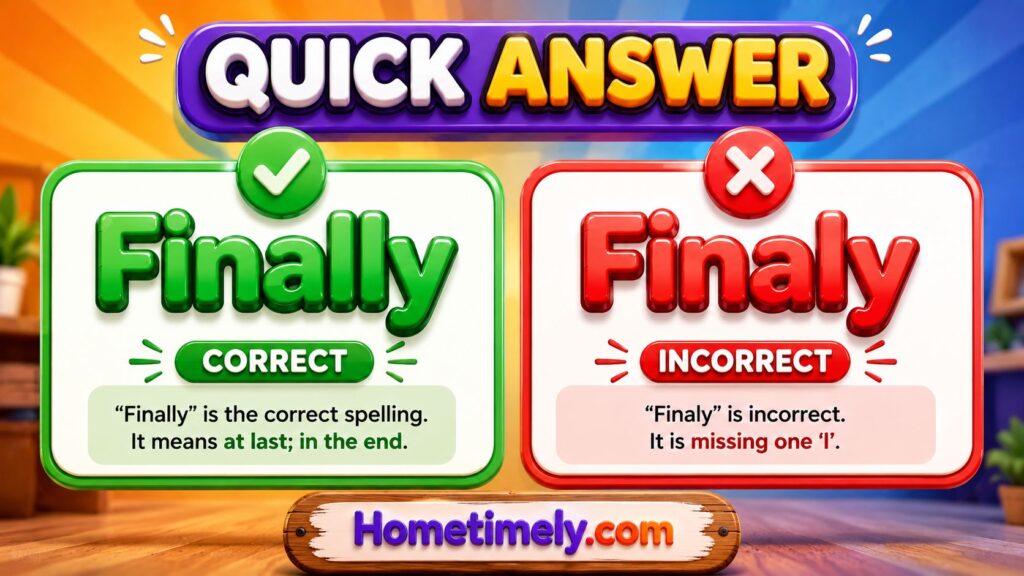
Finally vs Finaly: The Correct Answer
Let’s settle this immediately so the rest of the article can focus on helping you use the word well.
Finally is correct. ✅
Finaly is not a word. ❌
There is no dictionary — not Merriam-Webster, not Oxford, not Cambridge, not Collins — that recognizes finaly as a valid spelling. It does not appear in any style guide. Spell-checkers in Microsoft Word, Google Docs, and Grammarly will flag it as an error the moment you type it. There is no British variant, no American exception, no informal shorthand that makes finaly acceptable. It is simply a misspelling.
The correct spelling is finally — always written with a double l — and it works the same way everywhere in the English-speaking world.
| Spelling | Correct? | In Dictionary? | Passes Spellcheck? |
| Finally | ✅ Yes | ✅ Yes | ✅ Yes |
| Finaly | ❌ No | ❌ No | ❌ No |
Why do people write “finaly” by mistake?
This is the most interesting part of the story, and understanding the reason is the key to never making the mistake again.
The word finally is an adverb. Adverbs in English are most commonly formed by taking an adjective and adding the suffix -ly to the end. You probably know dozens of examples without thinking about it: quick becomes quickly, slow becomes slowly, clear becomes clearly, loud becomes loudly.
The problem with finally is that it comes from the adjective final — which already ends in the letter l. When you add the adverb suffix -ly, that existing l does not disappear. It stays. The -ly suffix gets added directly onto final, producing:
final + ly = finally (two ls total)
Most people intuitively want to simplify this. The word sounds like it has one soft l sound in the middle, which makes it tempting to write just one. That is where the mistake comes from — a combination of phonetic spelling (writing what you hear rather than what the rule requires) and a subconscious urge to avoid what feels like a doubled letter.
Other common examples where this same pattern trips people up include actually (actual + ly), totally (total + ly), formally (formal + ly), and naturally (natural + ly). In every single case, the adjective ends in -al and the double l is required. Finally belongs to exactly this group.
Once you see the pattern, the spelling becomes logical and easy to remember.
What Does “Finally” Mean?

Finally is an adverb, which means it modifies a verb, an adjective, another adverb, or even an entire clause. According to both Oxford and Cambridge dictionaries, it has three distinct but related uses in modern English, and knowing the difference between them will make you a noticeably stronger writer.
1. At last (after a long wait)
This is the most emotionally loaded use of the word, and almost certainly the most common. When something has taken longer than expected — whether that is minutes, years, or decades — finally captures the sense of relief, satisfaction, or exhaustion that comes with its arrival.
The word carries emotional weight here that alternatives like eventually or at last can only partially replicate. It implies that there was a wait, that the wait was felt, and that its end means something.
Examples:
- After three hours in traffic, we finally reached the airport.
- She studied for months and finally passed her driving test.
- The rain finally stopped after a week of grey skies.
- He finally called back after I had almost given up.
- The package finally arrived, two weeks late.
Notice how each of these sentences carries an implied backstory — a period of waiting, trying, or frustration that finally acknowledges without spelling out. That is one of the reasons the word is so useful and so frequently used.
2. In conclusion
This is the more formal, structured use of finally. When used at the beginning of a sentence or clause to introduce a final point, finally signals to the reader that this is the last item in a sequence. It functions similarly to lastly, in conclusion, or to sum up, but it tends to be cleaner and less wordy.
This usage is especially common in academic writing, speeches, formal presentations, and structured essays. Oxford’s usage notes specifically highlight this function, noting that finally is particularly common in formal contexts when introducing a concluding argument or point.
Examples:
- First, we will examine the data. Second, we will assess the findings. Finally, we will present our recommendations.
- The proposal includes three sections: an overview, a budget breakdown, and finally, a timeline.
- Finally, I would like to thank the committee for their time and consideration.
- The report addresses staffing concerns, budget gaps, and finally, long-term strategic goals.
In this use, finally acts as a discourse marker — a word that organizes information and guides the reader through a structured argument.
3. After many attempts or steps
This third use sits between the first two. It applies when something happens at the end of a process that involved multiple steps, repeated efforts, or sustained work — not just passive waiting. The emphasis is on completion after effort, rather than completion after delay.
Examples:
- After months of revisions, the design team finally agreed on a logo.
- She finally managed to fix the leak after watching three tutorials.
- The negotiations finally produced a result that satisfied both parties.
- He finally understood the concept after his teacher explained it differently.
- The investigators finally identified the source of the problem.
In all three uses, the spelling is identical. Finally does not change based on how it is being used, which makes remembering it simpler. The rule never shifts: two ls, every time.
How to Spell Finally Correctly (Easy Trick)
Knowing the correct spelling is one thing. Being able to recall it instantly under pressure — while typing quickly, when your spellchecker is turned off, or when you are writing by hand — is another. Here are the most practical memory techniques for locking in the correct spelling permanently.
The formula trick (most reliable): Break the word into its parts: final + ly = finally. If you can spell final — and you almost certainly can — then the rest follows automatically. The adjective final already has an l at the end. The suffix -ly adds another one. Count them: that is two, which is exactly what you need.
The family comparison: Think of the adverb family that finally belongs to: actually, totally, formally, naturally, morally, basically. Every single one of these comes from an adjective ending in -al and every single one has a double l in its adverb form. Finally is no different. Once you see it as part of a consistent group, it stops feeling like an exception.
The “feels full” rule: Some people find it helpful to think of the double l as making the word feel complete and full. Finaly looks thin and unfinished. Finally looks solid. This is a subjective approach, but for visual learners it can work surprisingly well.
The pronunciation anchor: Say the word slowly out loud: FYE-nuh-lee. Notice that the middle syllable ends in a clear l sound before the lee ending. When you spell it out phonetically and carefully — not the rushed version — the double l can be heard more distinctly. Use that as your anchor.
The spellchecker habit: For anyone still unsure: build the habit of running a quick spellcheck on any document before sending or publishing. Every major word processor and most email clients will catch finaly immediately. This takes two seconds and protects your credibility every time.
Common Spelling Confusion: Finally or Finaly

It is worth taking a moment to look honestly at the landscape of English spelling and acknowledge why confusion like this is so persistent. English is not a phonetically consistent language. Its spelling rules have been shaped by centuries of borrowing from Latin, French, Old Norse, and Germanic languages, each of which contributed their own patterns and exceptions.
The -al + -ly pattern that produces finally is genuinely non-obvious. If you hear the word spoken casually in conversation, the double l is not strongly emphasized. Fast speech compresses it further. And because people learn spelling through reading as much as through explicit instruction, anyone who has simply not encountered the word often in print might rely on phonetic intuition — which points toward finaly.
This is also compounded by the fact that many common English words do simplify double letters in related forms. The noun finality has a clear double l sound. The adjective final has one. When forming the adverb, some learners mistakenly assume the same simplification applies.
None of this makes finaly correct. But it does explain why the mistake is so widespread and why it happens to careful writers as well as casual ones.
The good news: once you learn the final + ly = finally formula, you will never need to wonder again.
Also Read This : Finaly vs Finally: Differences and Usage
Why Correct Spelling Matters
Some people argue that in the age of autocorrect and predictive text, spelling matters less than it used to. This is partly true in casual contexts. But in professional, academic, and public-facing writing, correct spelling still carries significant weight — for several concrete reasons.
Credibility and first impressions. Readers notice spelling errors, often more than they notice good spelling. A misspelling in a resume, a cover letter, a client proposal, or a published article creates a subtle but real impression of carelessness. In competitive contexts, that impression has consequences.
SEO and digital content. For anyone publishing content online, correct spelling directly affects search performance. Search engines index exact spellings and match them to search queries. A page that consistently uses finaly instead of finally will not rank well for the far more common correct-spelling searches. This is not theoretical — misspellings cost visibility.
Academic standards. In academic writing, spelling errors can affect grades, peer review outcomes, and the perceived rigour of an argument. Professors and reviewers are human; repeated errors create friction that works against the writer.
Communication clarity. While finaly is usually understandable in context, correct spelling removes any ambiguity and keeps the reader focused on the content rather than the mechanics.
In short: getting spelling right is not pedantry. It is a practical skill with real professional and reputational consequences.
Quick Usage Examples of “Finally”
Here is a broad set of correct usage examples across different tones and contexts, all demonstrating proper spelling and natural sentence placement:
- The summit finally reached an agreement after days of intense negotiation.
- I finally found a coffee shop that gets my order right.
- After years of delays, the infrastructure bill was finally signed into law.
- She had been waiting for the results for weeks, and they finally arrived.
- Finally, let me address the concern that was raised in last week’s meeting.
- The software update finally includes the dark mode everyone requested.
- We finally moved into the new office after months of renovation.
- He finally admitted that he had been wrong.
- The missing piece of evidence finally came to light during the trial.
- After a difficult year, the team finally celebrated their first championship.
Each of these demonstrates finally used naturally — positioned in different parts of the sentence, applied in different emotional registers, and functioning across both its time-related and structural uses.
Finally in Everyday Examples
One of the best ways to solidify correct spelling and usage is to see a word functioning naturally in the types of contexts you actually encounter every day. Here is how finally appears across different real-world writing settings.
Emails
Professional emails are one of the most common places where spelling errors are noticed and where they do the most damage to credibility.
- “We finally have confirmation from the client — the project is approved.”
- “I’m writing to say that the issue has been finally resolved.”
- “Finally, I’ve attached the updated contract for your review.”
- “After several rounds of revisions, the report is finally complete.”
News
Journalists use finally frequently to signal long-awaited developments, resolutions, or conclusions.
- “The city council finally approved the new transit plan after three years of debate.”
- “Investigators finally identified the cause of the outage.”
- “The bill, stalled for months, has finally passed the Senate.”
- “Scientists have finally confirmed what researchers suspected for decades.”
Social Media
Informal but still highly visible, social media writing benefits from correct spelling just as much as formal writing does.
- “We finally launched! Check out our new website 🎉”
- “Finally finished this project after working on it for six months.”
- “After months of waiting, the sequel is finally here.”
- “I finally tried that recipe everyone was talking about.”
Formal Writing
In academic papers, reports, and official documents, finally is frequently used as a structural signal in argumentation.
- “The data supports three conclusions. First, adoption rates are rising. Second, user satisfaction has improved. Finally, cost efficiency has increased significantly.”
- “Finally, this research contributes to the growing body of evidence that supports early intervention.”
- “The committee reviewed the proposal and finally reached a unanimous decision.”
Daily Conversation
In spoken English and casual written exchanges, finally appears constantly as an expression of relief or resolution.
- “I finally figured out why my laptop keeps crashing.”
- “She finally texted me back!”
- “We finally booked the flights — we’re actually going.”
- “The baby finally fell asleep.”
In every single one of these examples, the spelling is finally — the same double l, the same structure, the same word regardless of the formality of the context.
Finally or Finaly – Usage Data
Search engine data tells a revealing story about this spelling question.
Why people search this keyword:
The searches around finaly or finally are almost entirely driven by writers seeking confirmation of the correct spelling — not by confident users of the wrong form. This matters because it indicates genuine uncertainty rather than widespread intentional use of a variant. Most people who type finaly do so accidentally or through phonetic habit, and they recognize something is off when they look at the word.
Search interest in this topic spikes among:
- English language learners across South Asia, East Asia, and Latin America
- Students preparing academic papers and essays
- Professionals proofreading emails and formal documents before sending
- Content writers and bloggers who want to ensure their published material is error-free
Popular regions:
Interest in this spelling question is global, with notably high search volume in:
- South Asia (India, Pakistan, Bangladesh) — where English is widely used in professional and academic settings but is often learned as a second language
- Southeast Asia (Philippines, Indonesia, Malaysia) — large populations of English writers across educational and professional contexts
- Africa (Nigeria, Kenya, Ghana, South Africa) — where English-medium education is standard
- United Kingdom and United States — even native speakers search this, particularly younger users and those who learned spelling informally
Usage contexts:
The word finally appears across an extremely wide range of text types:
- Academic essays and research papers
- Professional emails and business correspondence
- News articles and journalism
- Social media posts and captions
- Creative writing and fiction
- Speeches and presentations
- Product reviews and blog posts
- Legal and official documents
In all of these contexts, the correct spelling is the same: finally.
Comparison Table (Keyword Variations)
The table below addresses the most common questions and keyword variations people search when looking for help with this word. All roads lead to the same answer.
| Search Query / Variation | Correct Form | Notes |
| finaly or finally | finally | Two ls — always |
| finally or finaly | finally | No exceptions |
| how to spell finally | f-i-n-a-l-l-y | Seven letters total |
| finaly correct spelling | Not correct | The correct spelling is finally |
| finally meaning | At last / in conclusion / after effort | Adverb with three uses |
| finaly meaning | N/A | Not a word |
| finally British English | finally | Same as American English |
| finally American English | finally | Same as British English |
| final vs finally | Different words | Final = adjective; Finally = adverb |
| finally synonym | Eventually, at last, ultimately, lastly | Context-dependent |
| finally in a sentence | “She finally arrived.” | Placed near the verb it modifies |
| finally pronunciation | /ˈfaɪ.nəl.i/ | Three syllables: FYE-nuh-lee |
| finally etymology | Old French final + Latin finalis + suffix -ly | Traced to Latin finis meaning “end” |
| finally vs eventually | Overlapping but distinct | Finally implies conclusion; eventually implies inevitable future |
| finally vs lastly | Both valid in conclusion use | Lastly is more formal; finally is more common |
| is finaly a word | No | Misspelling of finally |
| finally adverb | Yes | Modifies verbs, clauses, and sentences |
| correct spelling final + ly | finally | Double l retained from base word |
Bringing It All Together
The question of finally or finaly has one clear, consistent, and unambiguous answer: it is always finally, always with two ls, in every context, in every variety of English, in every type of document you will ever write.
The reason people get it wrong is logical — the adjective final has one l, and adding a suffix intuitively feels like it should not double it. But English adverb formation does not work that way. The suffix -ly attaches directly to the full base word, which means the l from final and the l beginning -ly sit side by side in the final word. That is the rule, and it is consistent across the entire family of adjectives ending in -al: finally, actually, totally, formally, naturally, and many more.
Every major dictionary, every reputable style guide, every spellchecker, and every grammar authority agrees: the only correct spelling is finally.
The simplest way to remember it forever is this: final + ly = finally. Write it out a few times. Say it slowly. Let the formula replace the instinct. After a short while, finally will look right — and finaly will immediately look wrong, the way misspellings do once you have learned the correct form.
Now you know. Use it with confidence, spell it correctly, and never second-guess it again.

Michael Brook is the creator and author behind Healthy Leeks, a platform focused on grammar, writing skills, and English language learning. Passionate about clear communication and effective writing, Michael Brook shares practical grammar tips, easy-to-follow language guides, and educational content to help readers improve their English with confidence.


