
Have you ever typed “I am so exited for this trip!” and hit send — only to realize something felt off? You are not alone. Excited and exited are among the most commonly confused word pairs in the English language, not because people do not know the difference in meaning, but because they look and sound almost identical at a glance. One stray letter changes everything.
Whether you are crafting a professional email, writing a school essay, or posting on social media, using the wrong word can quietly undermine your credibility. This complete guide breaks down the meaning, usage, origin, and subtle nuances of both words — so you never mix them up again.
What “Excited” Really Means
Excited is an adjective (and the past participle of the verb excite). It describes a state of heightened emotion — typically joy, enthusiasm, eagerness, or anticipation. When someone is excited, they are emotionally stirred up about something, whether it has already happened or is about to.
Think of the feeling before a birthday party, a job interview you have been preparing for, or a long-awaited vacation. That inner energy — that buzz — is exactly what excited captures.
Beyond everyday emotional use, the word also appears in scientific and technical contexts. In physics, an atom or electron that has absorbed energy and moved to a higher energy state is described as excited. In biology or medicine, an excited state can describe nerve cells or tissues responding to a stimulus.
Part of speech: Adjective / past participle
Base verb: excite
Related words: excites, exciting, excitement, excitable
Quick definition: Feeling or showing eagerness, enthusiasm, or heightened emotional energy.
What “Exited” Really Means
Exited is the simple past tense and past participle of the verb exit, meaning to leave, depart, or go out of a place. It is an action word — it describes something that physically happened: a person, vehicle, animal, or even data that left a specific location or program.
You will see exited in news reports, legal documents, stage directions, and everyday narrative writing whenever the story calls for someone or something to have departed.
Part of speech: Verb (past tense)
Base verb: exit
Related words: exits, exiting, exit (noun)
Quick definition: Left or departed from a place, system, or situation.
Side by Side Comparison of Excited vs Exited
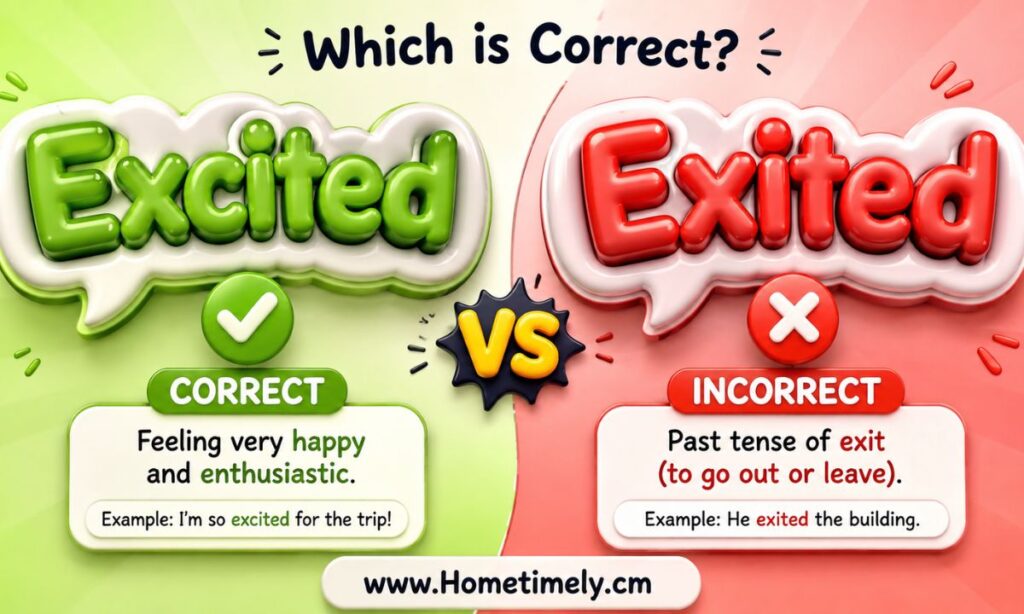
At first glance, these words look nearly identical. But their meanings, grammatical roles, and contexts are entirely different. Here is a direct comparison:
| Feature | Excited | Exited |
| Part of speech | Adjective / past participle | Verb (simple past) |
| Base word | Excite | Exit |
| Core meaning | Feeling enthusiastic or eager | Departed or left a place |
| Used to describe | Emotions, feelings, states | Physical actions or movement |
| Sentence role | Describes a person’s state | Describes an action that occurred |
| Example | She is excited about the news. | He exited the building quickly. |
| Synonyms | Thrilled, eager, enthusiastic | Departed, left, vacated |
| Origin | Latin excitare (to rouse) | Latin exitus (a going out) |
The core difference is simple: excited = emotion; exited = movement. Keep that contrast in mind and you will never confuse them again.
How to Use Excited and Exited in Sentences

Using Excited in Sentences
Excited functions as an adjective, so it describes a noun — almost always a person or group. It typically follows linking verbs like is, was, are, were, feel, or seem, or it can come directly before the noun it modifies.
- The children were excited to open their gifts on Christmas morning.
- She felt genuinely excited when she received the acceptance letter.
- He is excited about starting his new business next month.
- The crowd grew excited as the final minutes of the match approached.
- An excited puppy bounded across the yard to greet her owner.
- Scientists observed that the excited electrons released photons as they returned to their ground state.
- We are excited to announce that our new product launches this Friday.
Notice that in every case above, excited is telling us how someone feels — it is emotional, internal, and descriptive.
Using Exited in Sentences
Exited is the past tense of the action verb exit. It tells us that something or someone left a location, a program, a market, or a situation. It is past-tense and action-oriented.
- The last passenger exited the plane just before the storm arrived.
- She exited the highway at Junction 14 and turned left.
- After the argument, he quietly exited the room without another word.
- The company exited the Southeast Asian market after three years of declining revenue.
- The suspect exited through the rear door, according to surveillance footage.
- The application exited unexpectedly, and all unsaved work was lost.
- The actor exited stage left following the climactic monologue.
In each sentence above, exited describes a physical or figurative act of leaving — there is no emotion involved, only movement or departure.
Comparison Table for Clarity
| Incorrect Usage | Correct Usage | Why |
| I am so exited for the concert! | I am so excited for the concert! | Feeling = excited |
| She excited the room in a hurry. | She exited the room in a hurry. | Physical action = exited |
| He was exited about the promotion. | He was excited about the promotion. | Emotion = excited |
| The team excited the tournament early. | The team exited the tournament early. | Departure = exited |
| We are exited to share this update. | We are excited to share this update. | Enthusiasm = excited |
Common Mistakes and How to Avoid Them
The most frequent error is writing exited when the intended meaning is excited. This happens because:
- Fast typing: Both words are long and similarly structured. Autocorrect sometimes steps in unhelpfully.
- Phonetic similarity: In casual speech, especially at speed, both words can blur together audibly.
- Visual similarity: They share seven of their eight letters — only the placement of the “c” differs.
How to avoid the mistake:
- Ask yourself: Am I describing a feeling or a physical departure? Feeling → excited. Departure → exited.
- Use a memory trick: “Excited has a ‘c’ — and so does ‘cheer.'” When you want to cheer about something, you are excited.
- Read your sentence aloud and ask if it makes sense. “I am exited for the weekend” sounds odd when you truly mean you are feeling enthusiastic.
- Proofread slowly. One of the easiest fixes is simply pausing before you publish or send.
Advanced Usage Notes
Excited as a predicate adjective vs. attributive adjective:
Excited can appear either before the noun (an excited crowd) or after a linking verb (the crowd was excited). Both are grammatically correct.
Excited in passive constructions:
Because excited is also the past participle of excite, it can appear in passive voice: “The audience was excited by the announcement.” Here, the announcement did the exciting — the audience received the action. This differs slightly from simply “The audience was excited,” where no agent is named.
Exited in technical writing:
In software, IT, and engineering contexts, exited appears frequently: “The process exited with error code 0” or “The user exited the session.” This is formal, action-based language — never emotional.
Exited in finance and business:
In investment and business strategy, exit is used as a technical term. A company that has left a market, and an investor who has sold a position, both use exited: “The venture capital firm exited the deal at a significant profit.”
British English vs American English Spelling
One area where learners sometimes wonder if regional differences play a role — they do not, at least not here.
Both excited and exited are spelled identically in British English and American English. There is no -ise/-ize or -our/-or variation to worry about. The words look exactly the same on both sides of the Atlantic.
| Word | British English | American English |
| Excited | excited | excited |
| Exited | exited | exited |
What does vary slightly between British and American English is how the words appear in context. British writers may use more formal phrasing — “I was rather excited to learn…” — while American usage tends toward the direct: “I was so excited when…” However, the spelling and fundamental grammar rules are the same everywhere English is written.
The Origin of Excited and Exited
Understanding where these words come from makes it much easier to remember the difference.
The Origin of “Excited”
The word excite entered Middle English around the 14th century, borrowed from Old French esciter and directly from the Latin excitare, meaning “to rouse, call out, summon forth, or produce.” The Latin root is built from ex- (meaning “out”) and ciere (“to set in motion” or “to call”), which traces back to the Proto-Indo-European root *keie- (“to set in motion”).
By the early 15th century, English speakers were using excite to describe stirring up emotions. The modern sense of “to rouse someone’s feelings of eagerness or anticipation” solidified by the early 1800s. The adjective form excited developed naturally from the past participle.
The Origin of “Exited”
The verb exit has a different Latin ancestor entirely. It comes from Latin exitus, a noun meaning “departure, a going out, or a way by which one may leave.” That noun derived from the verb exire (to go out), itself a compound of ex- (out) and ire (to go).
The word entered English as a stage direction in theatrical writing — “Exit Hamlet” in a Shakespeare script meant “Hamlet leaves the stage.” Over time, exit evolved from a theatrical instruction into a general verb. Exited, its past tense, followed naturally.
So while both words share the Latin prefix ex- (meaning “out”), they branch from completely different Latin roots: excitare (to rouse) vs. exitus (a departure). Two separate Latin words — two very different English meanings.
Common Mistakes to Avoid
Beyond the basic confusion of one word for the other, writers sometimes fall into subtler traps:
Mistake 1: Using “exited” as an adjective
Wrong: She looked exited to see him.
Right: She looked excited to see him.
Exited is a verb, not an adjective. It cannot describe how someone looks or feels.
Mistake 2: Confusing “exited” with “exhausted”
Wrong: After the long run, I was exited.
Right: After the long run, I was exhausted.
Tired, drained feelings require exhausted — not exited.
Mistake 3: Dropping the “c” in “excited” when typing quickly
This is perhaps the most common error in text messages and social media. Autocorrect may not catch it because exited is a real word. Always double-check before posting.
Mistake 4: Assuming “exited” is just a misspelling of “excited”
Exited is a completely real and valid English word — it just means something different. Treating it as a typo can make you miss genuine meaning in a sentence.
Mistake 5: Overusing “excited” in formal writing
In professional emails and business communication, excited is perfectly fine. But be aware that some formal registers prefer alternatives like pleased, eager, enthusiastic, or looking forward to — especially in very corporate or academic writing.
Excited vs Exited in Different Contexts
The right word depends heavily on context. Here is how each one fits into different real-world situations:
In everyday conversation and social media:
Almost always, people mean excited. “I’m so exited for the weekend” is nearly always a typo or mistake.
In news reporting and journalism:
Exited appears frequently: “The CEO exited the company following the board’s decision.” Excited appears in descriptions of crowd reactions: “Fans were excited by the team’s comeback.”
In academic or scientific writing:
Both words appear, but in very specific senses. Excited may describe atomic or molecular states; exited describes participants leaving a study or simulation.
In business and finance:
Exited is a technical term for leaving an investment or market: “The fund exited its position.” Excited appears in marketing and product launch copy: “We are excited to introduce our newest innovation.”
In theatre and screenplay writing:
Exited is used in stage directions (She exited stage right) while excited describes a character’s emotional state (He was excited to see her).
In software and technology:
Exited dominates: “The program exited with an error,” “The user exited the dashboard.” Emotional language like excited is rare in technical documentation.
Also Read This : Nonresponsive vs Unresponsive: Differences and Usage
Exceptions and Special Cases
Can “exit” be used as a noun?
Yes. Exit itself is both a verb and a noun (“Take the next exit on the highway”). But exited is always a verb form — it cannot be used as a noun.
Is “excited” ever used to describe non-human things?
Yes, though less commonly in casual writing. Scientists describe excited states of atoms and molecules. Engineers may describe excited frequencies in a vibrating system. In these contexts, excited has no emotional meaning whatsoever — it simply means “in an elevated or activated state.”
Can “exited” have a metaphorical meaning?
Yes. In business, finance, and politics, exited is used figuratively: “Britain formally exited the European Union in 2020.” “The startup exited via acquisition.” No physical door was walked through — but the departure or withdrawal is real.
Is “self-excited” a word?
In engineering, yes. A self-excited oscillator or generator produces its own excitation signal. This is a highly technical use and not related to emotional excitement.
Practice Exercises
Test your understanding with these fill-in-the-blank exercises. Choose either excited or exited for each sentence.
1. The investors __________ the market before the crash.
2. The children were __________ about the school trip to the science museum.
3. She __________ the program by pressing the escape key.
4. I am so __________ to finally meet you in person!
5. After his speech, the senator __________ through a side door.
6. The dog was visibly __________ when it heard the word “walk.”
7. The athlete __________ the competition after suffering an injury.
8. We are __________ to announce our partnership with a global brand.
Answer Key:
- exited (they departed from the market)
- excited (they felt eager and enthusiastic)
- exited (she left the program)
- excited (feeling of anticipation)
- exited (he left through a door)
- excited (emotional reaction)
- exited (withdrew from the competition)
- excited (expressing enthusiasm)
If you got all eight correct — great work. If any tripped you up, go back and review the comparison table or the usage examples above.
Wrapping It Up
The gap between excited and exited is small on the page but large in meaning. One speaks to the heart — to enthusiasm, eagerness, and anticipation. The other speaks to movement — to departure, withdrawal, and leaving. Understanding that core distinction is all you need.Remember the quick rule: excited = emotion, exited = exit. Apply it every time you write either word, and you will never send the wrong one again. Strong, precise word choice is one of the simplest ways to sharpen your writing — and now you have one more tool in your arsenal.

Michael Brook is the creator and author behind Healthy Leeks, a platform focused on grammar, writing skills, and English language learning. Passionate about clear communication and effective writing, Michael Brook shares practical grammar tips, easy-to-follow language guides, and educational content to help readers improve their English with confidence.