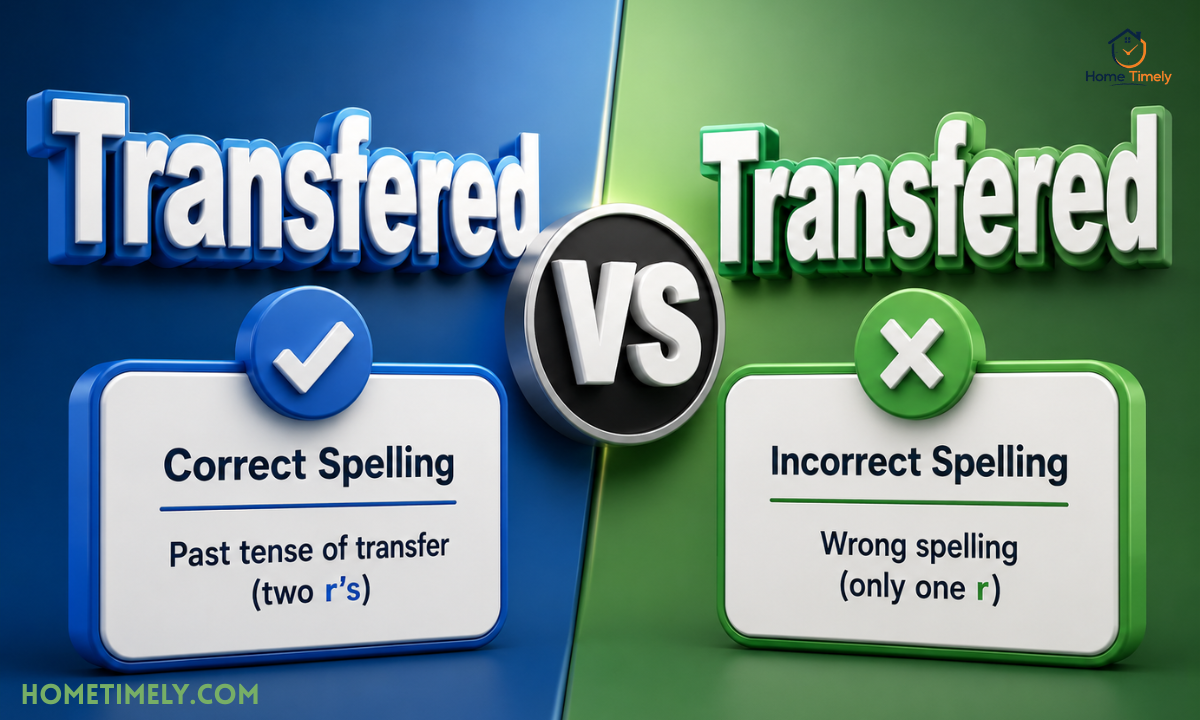
You are drafting a professional email, filling out a bank form, or updating a work report — and then it happens. You pause mid-sentence and stare at the word. Is it transferred or transfered? One looks right. The other looks like it could be right. You type one, delete it, type the other.
Here is the short answer: transferred is always correct. Transfered is always wrong.
But knowing why one is correct and the other is not will save you from repeating this pause every time you write the word. This guide explains the spelling rule, breaks down every related form, covers British and American English, includes real sentence examples, and closes with a memorable trick you will not forget.
Which Is Correct: Transferred or Transfered?

Transferred — with double R — is the correct spelling in every variety of English. Transfered — with a single R — is a misspelling and does not exist in any reputable dictionary.
Key Points
- Transferred is the past tense and past participle of the verb transfer
- Transfered violates a core English spelling rule and is never accepted in formal or informal writing
- Both American English and British English spell it transferred — no regional exception applies here
- Spell-check tools and major dictionaries (Merriam-Webster, Cambridge, Oxford) all recognize only transferred
Quick Comparison Table
| Form | Correct? | Notes |
| Transferred | ✅ Yes | Standard spelling in all English dialects |
| Transfered | ❌ No | Misspelling — missing the double R |
| Transferring | ✅ Yes | Present participle, also requires double R |
| Tranfered | ❌ No | Missing both the S and double R |
Why “Transferred” Has Double R
The double R in transferred is not arbitrary. It follows one of the most consistent rules in English grammar: the consonant doubling rule.
Key Points
- The rule applies to verbs where the final syllable is stressed and ends in a single consonant preceded by a single vowel
- Transfer is pronounced trans-FER — the stress falls on the second syllable -fer
- Because the stress is on -fer, and it ends in vowel + consonant (e + r), the final R must double before adding -ed or -ing
- Skipping the double R produces a misspelling: transfered
Rule Breakdown Table
| Condition | Transfer Fits? | Result |
| Ends in a consonant? | ✅ Yes (r) | Doubling applies |
| Preceded by a single vowel? | ✅ Yes (e) | Doubling applies |
| Final syllable is stressed? | ✅ Yes (trans-FER) | Doubling applies |
| Correct past tense | transferred | Double R required |
The same rule explains why prefer becomes preferred, refer becomes referred, and occur becomes occurred. Once you see the pattern, it becomes second nature.
Why “Transfered” Is a Common Mistake
If transfered is always wrong, why do so many people write it? There are several genuine reasons this error is so widespread.
Key Points
- Writers often add -ed directly to a base verb without applying the consonant doubling rule
- When spoken quickly, the double R in transferred is not always clearly audible — the ear does not always catch what the hand should write
- Many common English verbs do not double their final consonant (e.g., open → opened, happen → happened), which creates false confidence that transfer works the same way
- Non-native English speakers often lack exposure to the stress-based doubling rule, which is uncommon in many other languages
- Even spellcheck occasionally misses the error in certain software environments
Common Confusion Table
| What Writers Assume | Why It Is Wrong |
| Just add -ed to transfer | Ignores the consonant doubling rule |
| Pronunciation sounds like one R | Spelling is not always phonetic in English |
| Other verbs don’t double | Transfer meets all three conditions for doubling |
| It looks similar to entered | Enter is stressed on the first syllable — different rule |
Transferred vs Transfered: The Core Difference

Let us put this side by side so there is zero ambiguity.
Key Points
- Transferred follows standard English spelling rules for stressed-syllable verbs
- Transfered has no entry in any English dictionary — it is simply incorrect
- The difference is one letter, but that one letter reflects an important grammatical rule
Side by Side Table
| Feature | Transferred | Transfered |
| Spelling rule | Follows consonant doubling | Violates consonant doubling |
| Dictionary status | Recognized in all dictionaries | Not recognized anywhere |
| Professional use | Fully acceptable | Marks writing as careless |
| Correct in formal writing? | ✅ Always | ❌ Never |
| Correct in casual writing? | ✅ Always | ❌ Never |
Transferred: Meaning in Real Context
Transferred is the past tense and past participle of transfer, meaning to move, shift, send, or convey something — or someone — from one place, person, system, or role to another.
Key Points
- The word is used across finance, technology, employment, medicine, sports, education, and legal contexts
- It can describe physical movement, digital data movement, ownership changes, and emotional or psychological shifts
- As a past participle, it works in perfect tenses: has transferred, have transferred, had transferred
- As a passive voice form: was transferred, were transferred, has been transferred
Meaning Table by Context
| Context | What “Transferred” Describes |
| Finance | Money moved between accounts |
| Technology | Data moved between devices or systems |
| Employment | An employee relocated to another department or office |
| Education | A student who moves to a new school or university |
| Medicine | A patient moved to a different ward or hospital |
| Sports | A player moved from one club to another |
| Legal | Ownership of property formally changed |
| Telecommunications | A phone call redirected to another line |
Examples of Transferred in Sentences
Seeing transferred used correctly in varied contexts is one of the best ways to make the spelling feel natural.
Key Points
- Transferred is used in both active voice (the subject does the action) and passive voice (the subject receives the action)
- The word functions as both a simple past tense verb and a past participle in perfect constructions
Sentence Comparison Table
| ❌ Incorrect (Transfered) | ✅ Correct (Transferred) |
| She transfered the funds yesterday. | She transferred the funds yesterday. |
| The files were transfered to the cloud. | The files were transferred to the cloud. |
| He has been transfered to the London office. | He has been transferred to the London office. |
| The patient was transfered to intensive care. | The patient was transferred to intensive care. |
| The footballer was transfered for a record fee. | The footballer was transferred for a record fee. |
More correct examples in context:
- The ownership of the vehicle was legally transferred to the new buyer.
- I transferred all my contacts from my old phone last night.
- The professor transferred her research credits to the new institution.
- Emergency funds were transferred to the disaster relief account within hours.
- The call was transferred to the billing department after a short wait.
Transfer Verb Forms Explained
Understanding the complete conjugation of transfer helps you spell every related form correctly.
Key Points
- All forms that use a vowel suffix (-ed, -ing) require the double R
- Forms that use a consonant suffix (-s) or no suffix do not need the double R
Verb Forms Table
| Form | Correct Spelling | Example Sentence |
| Base form | transfer | I transfer files every morning. |
| Third person singular | transfers | She transfers data between servers. |
| Past tense | transferred | He transferred schools last year. |
| Past participle | transferred | The funds have been transferred. |
| Present participle | transferring | She is transferring the call now. |
| Adjective | transferable | These skills are highly transferable. |
Transferred vs Transferring
Both transferred and transferring are correct — and both require the double R. They differ only in their grammatical function.
Key Points
- Transferred is the past tense / past participle (completed action)
- Transferring is the present participle (ongoing action)
- Both double the R before the suffix because transfer meets all three consonant-doubling conditions
Comparison Table
| Feature | Transferred | Transferring |
| Tense / form | Past tense / past participle | Present participle |
| Suffix added | -ed | -ing |
| Double R required? | ✅ Yes | ✅ Yes |
| Example | She transferred the funds. | She is transferring the funds. |
| Used in perfect tenses? | ✅ Yes (has transferred) | ❌ No |
| Used in continuous tenses? | ❌ No | ✅ Yes (is transferring) |
UK vs US English: Is There Any Difference?
This is a common question, and the answer is refreshingly simple.
Key Points
- Both British English and American English spell it transferred — there is no regional variation
- Some verbs like cancel differ between US (canceled) and UK (cancelled), but transfer is not one of them
- The consonant doubling rule operates the same way in both dialects for stress-based verbs like transfer
- Using transferred is safe for any audience anywhere in the English-speaking world
Regional Comparison Table
| Spelling | British English | American English | Correct? |
| transferred | ✅ Yes | ✅ Yes | Always correct |
| transfered | ❌ No | ❌ No | Always incorrect |
| transferring | ✅ Yes | ✅ Yes | Always correct |
| transferable | ✅ Yes | ✅ Yes | Standard in both |
| transferrable | Accepted by some | Rare | Less common but seen |
Transferred: Pronunciation Guide
Pronunciation is one reason writers misspell this word. If the double R is not clearly heard, it is easy to leave it out.
Key Points
- Transferred is pronounced: trans-FERD (two syllables in natural speech)
- The stress falls on the second syllable: trans-FER
- In natural, fast speech, the double R blends into a single sound — but spelling still requires two R’s
- Hearing the stress on -fer is your cue to double the R
Pronunciation Table
| Word | Phonetic | Syllables | Stress |
| transfer (verb) | /trænsˈfɜːr/ | trans-FER | Second syllable |
| transferred | /trænsˈfɜːrd/ | trans-FERD | Second syllable |
| transferring | /trænsˈfɜːrɪŋ/ | trans-FER-ing | Second syllable |
Tip: Say transfer out loud. Notice where your voice naturally emphasizes — it lands on -fer. That stress is your signal to double the R.
Common Mistakes Similar to “Transfered”
The consonant-doubling error is not unique to transfer. Many writers stumble over the same pattern in related words.
Key Points
- Any verb ending in a stressed vowel + consonant pattern requires doubling before -ed or -ing
- Knowing the group helps you spell the whole family correctly at once
Similar Words Table
| Base Verb | Wrong Spelling | Correct Spelling |
| transfer | transfered | transferred |
| refer | refered | referred |
| prefer | prefered | preferred |
| occur | occured | occurred |
| deter | deterd | deterred |
| infer | infered | inferred |
| confer | confered | conferred |
| defer | defered | deferred |
All of these follow the same rule: stressed final syllable + single vowel + single consonant = double the consonant before a vowel suffix.
How to Remember the Correct Spelling
Spelling rules are easier to retain when you anchor them to a clear trick or mental image.
Key Points
- The best memory aids connect the spelling rule to something visual or auditory
- Multiple strategies are available — pick the one that clicks for you
Memory Trick Table
| Strategy | How It Works |
| “trans-FER + RR” | Hear the stress on FER → double the R |
| The “referred” family | If you know referred, apply the same pattern to transferred |
| Vowel + consonant + stress | Three conditions = double the consonant |
| “Two R’s, no excuses” | Simply memorize: transferred always has two R’s |
| Think of “referral” | The extra R carries through the whole word family |
The simplest trick of all: Say the word out loud. When your voice stresses -fer, write two R’s. You will never drop one again.
Transferred: Synonyms and Usage
Expanding your vocabulary with synonyms for transferred makes your writing more varied and natural, especially in professional documents.
Key Points
- Synonyms allow you to avoid repeating transferred in the same paragraph
- The right synonym depends on context — not all synonyms are interchangeable
Synonym Table
| Synonym | Best Used When… |
| moved | Physical relocation of a person or object |
| relocated | A person or business moving to a new place |
| shifted | A subtle change in position or responsibility |
| conveyed | Formal transmission of ownership or information |
| forwarded | Sending a message, document, or call onward |
| reassigned | A person given a new role or posting |
| handed over | Informal transfer of responsibility |
| transmitted | Data or signal sent from one point to another |
Why “Transfered” Is Always Incorrect
Some writers wonder whether transfered might be acceptable in at least one context — casual texting, perhaps, or creative writing. The answer is no.
Key Points
- No major dictionary — not Merriam-Webster, Cambridge, Oxford, or Collins — lists transfered as an accepted variant
- There is no dialect, regional usage, or stylistic context where transfered is standard
- Unlike canceled/cancelled, which varies by region, transferred does not have an alternative form
- Using transfered in professional writing signals inattention and can reduce perceived credibility
Rule Violation Table
| Claim | Truth |
| “Transfered is the American spelling” | False — both dialects use transferred |
| “Transfered is acceptable in informal writing” | False — it is a misspelling in all registers |
| “Spell check will catch it” | Not always — some tools miss it |
| “It sounds right, so it must be okay” | English spelling is not always phonetic |
| “Only one R sounds correct when I say it” | Pronunciation can be misleading; the rule overrides the ear |
Practice Exercise
Test your understanding with these quick exercises. Answers follow each section.
A. Fill in the Blanks
Complete each sentence with the correct form.
- She __________ the money to her savings account last Friday.
- The IT team __________ all company data to the new server overnight.
- He has been __________ to the regional office in Dubai.
- The call was __________ to customer service after a brief hold.
- Ownership of the property was legally __________ in January.
Answers: 1. transferred 2. transferred 3. transferred 4. transferred 5. transferred
B. Multiple Choice Questions
Choose the correct spelling.
- The employee was __________ to another department.
- a) transfered b) transferred
- Which spelling is correct?
- a) transfered b) transferred
- The payment has been __________ successfully.
- a) transferred b) transfered
- The past tense of transfer is:
- a) transfered b) transferred
C. True or False
State whether each statement is true or false.
| Statement | Answer |
| “Transfered” is the British English spelling. | False |
| “Transferred” follows the consonant doubling rule. | True |
| Both US and UK English use “transferred.” | True |
| “Transfered” is acceptable in informal writing. | False |
| “Transferring” requires double R because of the same rule. | True |
D. Sentence Correction
Identify and correct the spelling error in each sentence.
- ❌ The files were transfered to the cloud storage. ✅ The files were transferred to the cloud storage.
- ❌ She has been transfered to a new role in the company. ✅ She has been transferred to a new role in the company.
- ❌ The bank confirmated the funds were transfered. ✅ The bank confirmed the funds were transferred.
- ❌ Data was transfered between the two systems automatically. ✅ Data was transferred between the two systems automatically.
E. Short Answer Questions
Q: Does transferred have one R or two?
A: Two R’s — transferred always uses double R.
Q: Is there any context where “transfered” is correct?
A: No. It is a misspelling in every context, dialect, and register.
Q: Why does “transfer” double the R when adding -ed?
A: Because the final syllable is stressed and ends in single vowel + single consonant.
Q: Is “transferring” also spelled with double R?
A: Yes — the same doubling rule applies to transferring.
Q: Is the spelling different in British and American English?
A: No. Both use transferred with double R.
Final Comparison Table: Transferred vs Transfered
| Feature | Transferred | Transfered |
| Correct spelling | ✅ Yes | ❌ No |
| Dictionary recognized | ✅ Yes | ❌ No |
| Follows consonant doubling rule | ✅ Yes | ❌ No |
| Used in professional writing | ✅ Yes | ❌ Never |
| British English | ✅ transferred | ❌ Not used |
| American English | ✅ transferred | ❌ Not used |
| Similar correct words | referred, preferred, occurred | — |
Easy Memory Trick
“If the stress falls on FER — always double the R.”
Say transfer out loud: trans-FER. You feel the emphasis on the second syllable. That emphasis is your signal. Double the R, add -ed, and you have transferred — every single time, without hesitation.
Think of the word family: referred, preferred, occurred, deterred. They all follow the same pattern. Master one and you have mastered them all.
Key Takeaways
Transferred:
- Always spelled with double R (transferred)
- Past tense and past participle of transfer
- Correct in all contexts, dialects, and registers
- Follows the consonant-doubling rule: stressed syllable + single vowel + single consonant
Transfered:
- Always a misspelling — not accepted anywhere
- No dictionary, style guide, or grammar resource recognizes it
- Not a regional variant — not an informal alternative — simply incorrect
The rule in one sentence: When a verb’s final syllable is stressed and ends in one vowel followed by one consonant, double that consonant before adding -ed or -ing.
Transfer → stress on -FER → double the R → transferred. Done.
Frequently Asked Questions (FAQs)
Is “transfered” ever correct?
No. Transfered is always a misspelling; no English dictionary or style guide accepts it.
Does “transferred” have one R or two?
Always two R’s — the consonant-doubling rule requires it.
Is “transferred” spelled differently in British and American English?
No. Both dialects use transferred with double R — no regional exception exists.
What is the present participle of transfer?
Transferring — also spelled with double R, following the same rule.
Is “transferable” one word or two?
One word, spelled transferable (single R is standard; transferrable with double R is also accepted in some dictionaries).
Why does “prefer” become “preferred” and not “prefered”?
The same reason as transfer — stressed final syllable with single vowel + consonant triggers the doubling rule.
Can spell check catch “transfered”?
Not always. Some tools miss it in certain contexts, so knowing the rule yourself is the safest approach.
Conclusion
The debate between transferred vs transfered has exactly one answer: transferred wins every time. The double R is not optional, not regional, and not a style choice. It is the direct result of a clear, consistent English spelling rule that applies across dozens of verbs — referred, preferred, occurred, deterred, and many more.
The next time you write the word, remember two things: stress falls on -FER, and that stress demands a double R. Write it confidently, spell it correctly, and move on. Your writing will look sharper for it.

Michael Brook is the creator and author behind Healthy Leeks, a platform focused on grammar, writing skills, and English language learning. Passionate about clear communication and effective writing, Michael Brook shares practical grammar tips, easy-to-follow language guides, and educational content to help readers improve their English with confidence.


