
If you’ve ever typed a sentence and paused halfway through wondering whether it’s “crain” or “crane,” you’re not alone. This is one of the most common spelling mix-ups in English, and the confusion usually comes down to how similar the two words sound out loud.
Here’s the short version: crane is the correct English word. Crain is not a standard word at all — it’s almost always a surname, a typo, or a misheard version of “crane.” Let’s break down exactly why, with clear examples so you never second-guess yourself again.
Crain
“Crain” has no accepted meaning as a common noun or verb in English. You’ll mostly see it as a last name (as in someone named Crain) or as a simple misspelling of “crane.”
Crane
“Crane” is a real, dictionary-recognized English word. It can refer to a tall wading bird, a heavy-duty lifting machine, or even the verb meaning to stretch your neck to see something.
Crain or Crane: Quick Answer
The correct spelling for everyday English writing is crane. Whether you’re describing a bird, a piece of construction equipment, or the act of stretching your neck, “crane” is the word you want.
Main Difference:
- Crane = a real English word (bird, machine, or verb)
- Crain = mostly a surname or a spelling error, not a standard word
Examples:
- Correct: “The sandhill crane flew over the wetlands.”
- Incorrect: “The sandhill crain flew over the wetlands.”
- Correct: “A tower crane lifted the steel beams into place.”
- Incorrect: “A tower crain lifted the steel beams into place.”
What Does “Crane” Mean?
The word “crane” carries a few different meanings depending on context, but two stand out as the most common.
1. Crane (Machine)
In construction and engineering, a crane is a large machine used to lift and move heavy materials like steel beams, shipping containers, and concrete blocks. Cranes are a familiar sight on almost every major building site.
Examples:
- “The crane operator carefully lowered the beam onto the frame.”
- “They rented a mobile crane for the bridge repair.”
- “Construction crews use overhead cranes inside large factories.”
2. Crane (Bird)
A crane is also a tall, long-legged, long-necked bird known for its graceful movements and impressive migratory flights. Cranes belong to the Gruidae family and are found on nearly every continent except Antarctica and South America.
Examples:
- “Thousands of sandhill cranes gather along the Platte River every spring.”
- “The whooping crane is one of the rarest birds in North America.”
- “In Japanese culture, the crane symbolizes long life and good fortune.”
As a verb, “crane” also describes the act of stretching your neck to get a better view, as in, “She craned her neck to see over the crowd.”
What Does “Crain” Mean?
“Crain” doesn’t appear in major dictionaries such as Merriam-Webster, Cambridge, or Oxford as a standalone word. It exists almost exclusively as a surname for example, people or fictional characters named Crain or as a simple typo caused by mishearing or mistyping “crane.”
Example:
- “Ms. Crain will be leading tomorrow’s meeting.” (used correctly as a surname)
- “The crain lifted the steel beam.” (incorrect — should be “crane”)
Crane vs Crain: Core Difference
The core difference is simple: one is a legitimate English word with multiple meanings, and the other is not a standard word at all.
Comparison Table:
| Feature | Crane | Crain |
| Word type | Noun, verb | Mostly a surname |
| Dictionary status | Recognized | Not recognized |
| Common meaning | Bird, machine, neck-stretching action | Person’s last name |
| Correct in standard writing | Yes | No (unless it’s a name) |
| Popularity trend | Common, widely used | Rare, name-only usage |
Why People Confuse Crain and Crane
There are a few clear reasons this mix-up happens so often.
1. Similar Pronunciation
Both words sound almost identical when spoken quickly, especially in casual conversation or with certain regional accents. The vowel sounds blur together, making it easy to mishear one for the other.
2. Typing Errors
Autocorrect and fast typing can easily turn “crane” into “crain,” especially on mobile keyboards where a single letter swap goes unnoticed.
3. Exposure to the Surname “Crain”
Because Crain is a fairly common surname (including in television, business, and public figures), people sometimes assume it’s an alternate spelling of the word “crane” rather than a completely different name.
How to Pronounce Crane
Getting the pronunciation right can help you remember the spelling too.
Pronunciation
“Crane” is pronounced /kreɪn/, rhyming with words like “train,” “rain,” and “brain.” Say it slowly: k-rayn. Notice the long “a” sound, which comes from the silent “e” at the end of the word — a classic English spelling pattern.
Crane in Construction
Cranes are essential machines in the construction and shipping industries, and there are several types depending on the job.
Types of Cranes:
1. Tower Crane
Tower cranes are the tall, fixed cranes you see on skyscraper construction sites. They offer excellent height and lifting capacity, making them ideal for tall buildings.
2. Mobile Crane
Mobile cranes are mounted on wheels or tracks, allowing them to move around a job site. They’re commonly used for shorter-term projects or smaller lifts.
3. Overhead Crane
Overhead cranes, also called bridge cranes, run along a track mounted near the ceiling of a factory or warehouse. They’re used to move heavy materials within an indoor industrial space.
Easy Trick to Remember the Correct Spelling
Here’s a simple way to lock in the correct spelling for good: think of the silent “e” at the end of “crane” as standing for “Equipment” or “Elegant” both words that describe what a crane is, whether it’s a lifting machine or a graceful bird. If you can picture the “e,” you’ll never drop it again.
Crane in Nature
In the natural world, cranes are known for their striking appearance, elaborate courtship dances, and long-distance migrations. They’re often seen as symbols of grace, loyalty, and longevity across many cultures.
Famous Crane Species:
- Sandhill Crane – common across North America, known for large migratory flocks
- Whooping Crane – one of the most endangered bird species in the world
- Red-Crowned Crane – a symbol of luck and long life in Japanese and Chinese culture
- Common Crane – widespread across Europe and Asia
Crane in Everyday Examples
The word “crane” shows up far more often than most people realize, across very different settings.
Daily Life
- “Dad had to crane his neck to see the TV from the kitchen.”
- “The moving company used a small crane to lift furniture to the balcony.”
Social Media
- “Just watched a crane lift an entire house onto a truck #construction”
- “Spotted a family of cranes at the lake this morning “
Educational Context
- Science classes often reference cranes when teaching about simple machines, levers, and pulleys.
- Biology lessons cover cranes as examples of migratory bird behavior.
Crain vs. Crane: What’s the Difference?
To put it plainly, “crane” is the standard, dictionary-approved English word with real meanings tied to birds, machines, and physical movement. “Crain,” on the other hand, functions almost entirely as a proper noun — a surname you’d see on a name tag or in a family tree, not in a sentence describing an object or action. If you’re writing anything other than someone’s last name, “crane” is always the safer and correct choice.
Common Mistakes with Crain and Crane
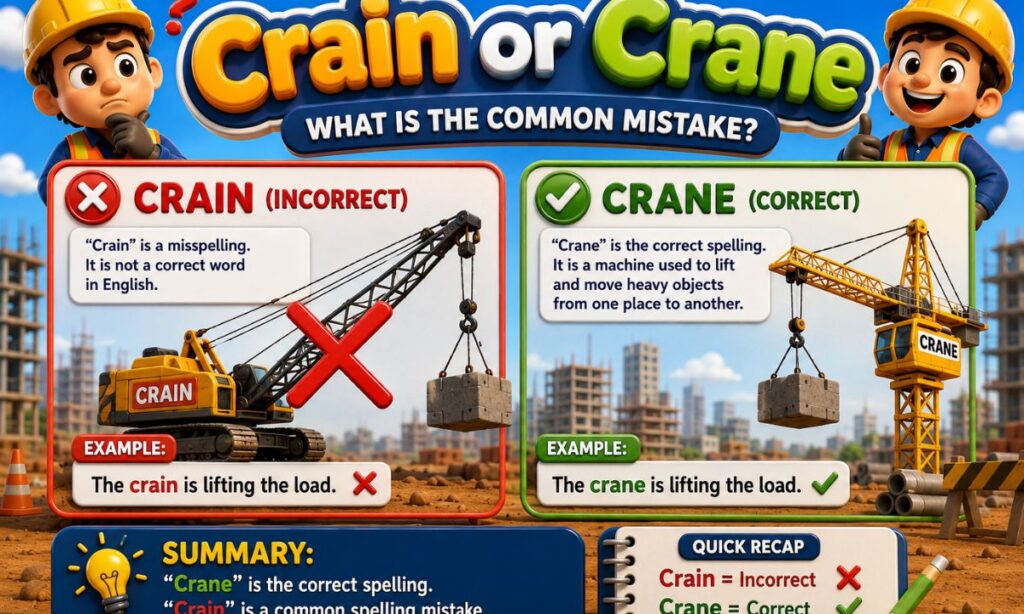
1. Writing “Crain” Instead of “Crane”
This is the most frequent error, usually caused by autocorrect, fast typing, or simply mishearing the word.
2. Assuming Crain Is Standard English
Some writers assume “crain” is a valid alternate spelling because it looks similar to other correctly spelled words. It isn’t.
3. Pronunciation-Based Spelling Errors
Because the two words sound so close, people sometimes spell what they hear rather than what’s actually correct.
4. Forgetting Crane Has Multiple Meanings
Writers sometimes only associate “crane” with the machine and forget it also refers to the bird or the verb, which can lead to confusion in context.
Memory Tricks to Remember Easily
If the spelling still trips you up, these quick tricks can help.
Trick 1: Crane Has an “E” Like Equipment
Cranes are equipment and both words share that long “e” sound at the end.
Trick 2: Think of Construction
Picture a construction site. The machine is a “crane,” not a “crain.” Visualizing the object helps cement the correct spelling.
Trick 3: Crane Rhymes with Train
“Crane” rhymes with “train,” “rain,” and “brain” — all common words that follow the same spelling pattern. If you can spell those, you can spell “crane.”
Also Read This : Cognisant or Cognizant: Which Spelling Is Correct?
British vs American English Usage
Unlike many words that change between British and American English (such as “colour” vs “color”), “crane” stays exactly the same on both sides of the Atlantic.
Key Point:
There is no regional variation for this word. “Crane” is correct in both UK and US English, and “crain” is incorrect in both.
Comparison Table:
| Region | Correct Spelling | Notes |
| American English | Crane | Used for bird, machine, and verb |
| British English | Crane | Identical spelling and usage |
| Any English dialect | Crane | No accepted regional variant is “crain” |
History of the Word “Crane”
The word “crane” traces back to the Old English term “cran,” which referred to the long-legged bird. Similar forms appeared across early Germanic languages, pointing to a shared linguistic root that goes back centuries. Over time, the meaning expanded beyond the bird: because early lifting devices had long, angled arms that resembled a crane’s neck, the machine eventually borrowed the same name. That connection between the bird and the machine is still the reason both meanings exist under one word today.
Comparison Table
| Aspect | Crane | Crain |
| Meaning | Bird, machine, verb | Surname only |
| Correct spelling | Yes | No |
| Found in dictionaries | Yes | No |
| Everyday usage | Very common | Rare (name only) |
| Pronunciation | /kreɪn/ | Same sound, wrong spelling |
Conclusion
When it comes down to it, “crane” is the word you want in virtually every situation whether you’re talking about a bird, a construction machine, or stretching your neck for a better view. “Crain” only belongs in a sentence if it’s someone’s actual last name. Keep the simple rhyme-with-“train” trick in mind, and you’ll never mix the two up again.

Michael Brook is the creator and author behind Healthy Leeks, a platform focused on grammar, writing skills, and English language learning. Passionate about clear communication and effective writing, Michael Brook shares practical grammar tips, easy-to-follow language guides, and educational content to help readers improve their English with confidence.