Ordinal numbers trip up even confident writers, and few cause as much hesitation as the number 31. Should you write “31st” or “31th”? If you’ve paused mid-sentence wondering which one looks right, you’re not alone — this is one of the most searched grammar questions in English writing.
This guide settles the question for good. You’ll learn the correct form, the grammar rule behind it, how the spelling is used in real-world writing, and the small mistakes that trip people up again and again. By the end, you won’t just know the answer — you’ll understand exactly why it’s true.
This kind of confusion is more common than most people admit. Ordinal numbers feel simple in theory but get messy once you move past the numbers 1 through 10. Add in dates, invitations, contracts, and casual texting, and it’s easy to see why “31st or 31th” ranks among the most frequently searched grammar questions online. The good news is that the rule, once explained clearly, is easy to remember for good.
31st or 31th: Quick Answer
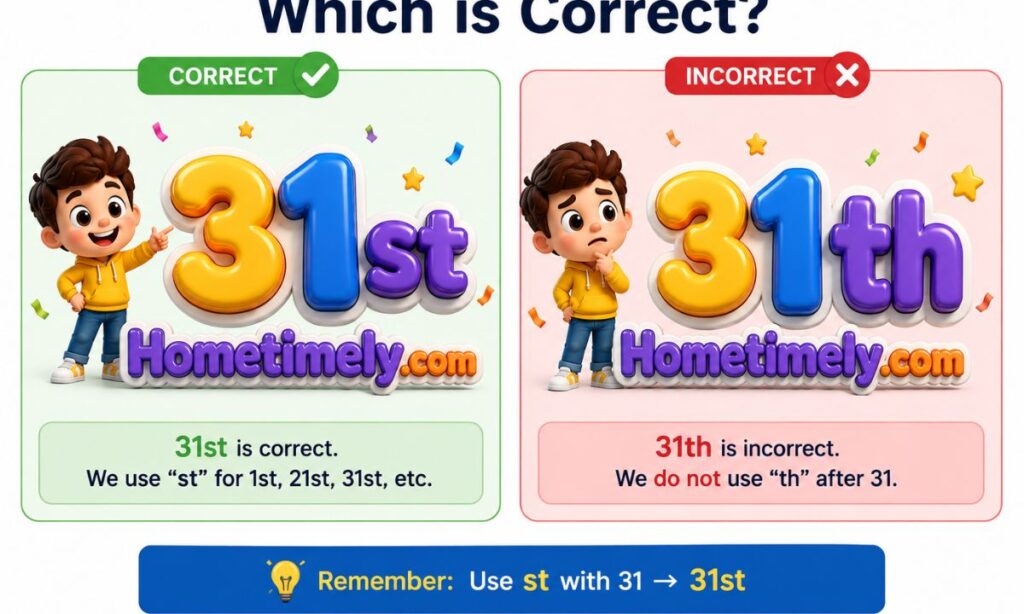
The correct form is 31st, not 31th.
English ordinal numbers take their ending from how the number is pronounced, not from a fixed pattern of “always add th.” Since 31 is spoken as “thirty-first,” the written form mirrors that pronunciation and ends in -st, just like the number 1 becomes 1st.
“31th” is a common typing mistake, not an accepted spelling. You will not find it in dictionaries, style guides, or professional publications. Whether you’re writing a date, a rank, or a birthday message, the only correct choice is 31st.
Here’s the rule in its simplest form:
- Numbers ending in 1 → add -st (1st, 21st, 31st, 41st)
- Numbers ending in 2 → add -nd (2nd, 22nd, 32nd)
- Numbers ending in 3 → add -rd (3rd, 23rd, 33rd)
- Every other number → add -th (4th, 15th, 30th, 100th)
The only exceptions are 11, 12, and 13, which always take -th (11th, 12th, 13th) regardless of the pattern above.
31st or 31th in Dates: Correct Usage Examples
Dates are where this mistake shows up most often, especially in emails, invitations, and calendars. Here’s how 31st should appear when paired with a month:
- January 31st marks the end of the first month of the year.
- The rent is due on March 31st.
- Independence celebrations often wrap up by May 31st.
- School holidays for many students begin around July 31st.
- Many companies close their financial year on August 31st.
- Contracts frequently list October 31st as a renewal deadline.
- Halloween always falls on October 31st.
- New Year’s Eve takes place on December 31st.
Notice that the pattern never changes based on the month. Whether it’s a business deadline or a birthday, 31 always becomes 31st because the underlying pronunciation — “thirty-first” — never changes either.
A quick formatting note: in standard writing, there’s no space between the number and the ending. “31 st” and “31 th” are both incorrect. The number and suffix are written as one unit: 31st.
It also helps to notice how naturally 31st fits into a sentence once you stop overthinking it. Read each example above out loud, and you’ll hear that the ending simply mirrors the way you’d already say the date. That’s really the entire trick behind ordinal numbers — the written form is just a shorthand for the spoken one, so if you can say a date correctly, you can almost always spell it correctly too.
This becomes especially useful when you’re writing quickly, such as replying to a calendar invite or drafting a text message. Instead of pausing to recall a spelling rule, simply say the number in your head. If it ends in “-first,” it takes -st. That single habit eliminates the vast majority of ordinal number mistakes, including the 31st-versus-31th confusion.
The Origin of 31st or 31th
To understand why 31st is correct, it helps to look at where ordinal endings come from in the first place.
Ordinal numbers exist to show position or rank within a sequence — first, second, third, and so on — rather than quantity. English inherited this system from Old English and Germanic roots, where certain numbers had irregular endings tied to how they were spoken aloud rather than a single mechanical rule.
That’s the key insight: ordinal suffixes follow pronunciation, not a uniform spelling pattern. The word “first” ends in an “-st” sound, “second” ends in “-nd,” and “third” ends in “-rd.” Every other ordinal in English happens to end in a “-th” sound, which is why -th became the default assumption for many learners.
When you reach compound numbers like 31, the same logic carries over. “Thirty-first” is built from “thirty” plus “first,” and only the final word in the phrase determines the ending. Since “first” ends in -st, the numeral form 31 becomes 31st. The same logic explains 21st, 41st, 51st, 61st, and every other number ending in 1 (except the 11-13 exceptions, which are historical irregularities of their own).
“31th” never existed as an accepted variant. It’s simply a spelling error that happens because -th feels like the “default” ordinal ending, when in reality it’s only one of four possible endings depending on pronunciation.
It’s worth noting that English is somewhat unusual in tying its ordinal spelling so closely to pronunciation. Many languages use a single consistent ordinal marker regardless of the final digit, which is part of why non-native speakers sometimes find English ordinal numbers harder to predict than they expect. Once you know that English ordinals are built from spoken compound words rather than a simple numeric formula, patterns like 21st, 31st, 41st, 51st, 61st, 71st, 81st, and 91st stop looking like isolated exceptions and start looking like one consistent, logical system.
This is also why grammar resources and English language authorities are unanimous on this point. There’s no ongoing debate among linguists, editors, or style guide authors about whether 31th could be valid — the pronunciation-based rule is treated as settled, foundational English grammar, on the same level as subject-verb agreement or plural formation.
British English vs American English Spelling
One question that comes up often: does British English write this number differently than American English? The short answer is no.
Both British and American English follow the exact same ordinal number rules. There is no regional variation for 31st — it’s written identically on both sides of the Atlantic. The only differences between British and American English in this area relate to date formatting order, not the spelling of the ordinal itself.
- American English typically writes dates as Month/Day/Year: December 31st, 2026
- British English typically writes dates as Day/Month/Year: 31st December 2026
Notice the ordinal spelling — 31st — stays exactly the same in both formats. Only the position of the day and month shifts.
Comparison Table
| Feature | American English | British English |
| Correct ordinal spelling | 31st | 31st |
| Date order | Month, Day, Year | Day, Month, Year |
| Example | December 31st, 2026 | 31st December 2026 |
| Spoken form | “December thirty-first” | “The thirty-first of December” |
| Use of “of” in dates | Rare | Common |
| Regional spelling variant of 31st | None | None |
As the table shows, the difference between the two English variants is about sentence structure and word order, not spelling. If you’re writing for a British audience, you might phrase it as “the 31st of October,” while American writing tends to favor “October 31st.” Either way, the ordinal itself never changes.
Which Form Should You Use?
Since 31th isn’t a recognized word in any style guide, dictionary, or grammar authority, there’s really only one form to use in any context: 31st.
Use 31st when you’re writing:
- Calendar dates (the 31st of any month that has 31 days)
- Rankings and positions (“she finished 31st in the marathon”)
- Ages and birthdays (“his 31st birthday”)
- Anniversaries and milestones (“their 31st wedding anniversary”)
- Lists, sequences, and step numbers
There’s no context — formal, casual, academic, or conversational — where 31th becomes acceptable. Unlike some grammar rules that shift depending on style guide or region (like the Oxford comma), this one is universal. Every recognized English-language authority agrees: 31st is correct, and 31th is a spelling mistake.
It’s also worth distinguishing between the numeral form (31st) and the word form (thirty-first). Most everyday writing — emails, calendars, social captions — uses the numeral form because it’s compact and instantly readable. Formal or literary writing sometimes prefers spelling the number out in full, especially at the start of a sentence, where starting with a numeral can look awkward:
- Numeral form: “The event starts on the 31st.”
- Word form: “Thirty-first in line was the last spot available.”
Either form is grammatically correct, and the choice usually comes down to house style rather than strict grammar rules. What never changes is the underlying ending — whether written as a numeral or spelled out, the number 31 always resolves to the “-first” / “-st” pattern, never “-th.”
Common Mistakes with 31st or 31th
Understanding why people make this error can help you avoid it permanently. Here are the most frequent patterns behind the mistake:
- Assuming every ordinal ends in -th. Many learners memorize -th as the “main” ordinal ending and mistakenly apply it everywhere, forgetting that 1, 2, and 3 (and numbers ending in them) follow different endings.
- Typing errors from muscle memory. Because so many ordinal numbers do end in -th (4th, 5th, 30th), some writers slip and type “31th” without noticing, especially when typing quickly.
- Confusing 31st with 30th. Since 30 correctly takes -th (thirtieth), some writers assume 31 follows the same pattern, not realizing the rule resets based on the final digit.
- Adding a space where none belongs. Writing “31 st” or “31 th” is also incorrect — the ending should be directly attached to the number with no space.
- Overcorrecting into “31rd.” Less common, but some writers swap in -rd because they know -th is wrong, without realizing -st is the correct fix.
- Mixing up spoken and written forms. Saying “thirty-oneth” out loud (which no native speaker actually does) can sometimes lead to a corresponding written error.
The simplest way to avoid all of these mistakes is to say the number out loud. “Thirty-first” clearly ends in the sound “first” — and that’s your built-in confirmation that the correct written form is 31st.
If you want an extra layer of protection against this mistake, try these quick habits:
- Read the sentence back before sending it. A quick re-read catches most ordinal typos, especially in emails and calendar invites.
- Use your device’s autocorrect or grammar checker. Most modern writing tools flag “31th” automatically, since it isn’t a recognized word.
- Memorize the four-number cluster. Numbers ending in 1, 2, or 3 (except 11, 12, 13) always take -st, -nd, or -rd. Everything else defaults to -th.
- Anchor it to a date you already know. Many people find it easier to remember that Halloween and New Year’s Eve both fall on the 31st — a small mental hook that reinforces the correct spelling every time it comes up.
With a little repetition, this stops being something you have to think about at all.
31st or 31th: Common Search Questions Answered
People searching for this topic tend to ask a related cluster of questions. Here are direct answers to the most common ones:
Is 31th ever correct in any form of English? No. Standard, formal, and informal English all use 31st exclusively. There is no dialect, region, or writing style where 31th is accepted.
Why does 31 use “st” instead of “th”? Because the number is pronounced “thirty-first,” and the final word “first” naturally takes the -st ending, just as it does when standing alone as 1st.
Is “31rd” ever used instead? No. This is a separate, less common mistake. The -rd ending belongs only to numbers ending in 3 (3rd, 23rd, 33rd). Thirty-one has no connection to that pattern.
Does the month change how 31 is written? No. Whether it’s January 31st or December 31st, the ordinal form stays identical. Only seven months (January, March, May, July, August, October, and December) actually have a 31st day, but the spelling rule applies the same way regardless of which month you’re referring to.
Is there a difference in formal versus casual writing? No. Formal writing, business communication, casual texting, and academic papers all follow the same rule. 31st is correct everywhere; 31th is incorrect everywhere.
Do style guides like AP or Chicago treat this differently? No major style guide recognizes 31th as an alternate spelling. Style guides may differ on whether to spell out ordinal numbers in full sentences (e.g., “thirty-first” versus “31st”), but none endorse 31th as a valid written form.
31st or 31th in Everyday Examples
Seeing the correct form across different writing contexts makes the rule easier to internalize. Below are realistic examples from everyday communication.
Emails
Emails often use ordinal dates for deadlines, meetings, and reminders. Getting this right adds a small but real layer of professionalism.
- “Please submit your report by January 31st at the latest.”
- “Our office will be closed from December 24th through December 31st.”
- “The invoice is due on the 31st of this month.”
- “I’d like to schedule our call for August 31st, if that works for you.”
News Writing
Journalists and news writers rely on precise, consistent date formatting, since dates often anchor the credibility of a story.
- “The policy takes effect on March 31st, according to officials.”
- “Voting will close at 8 p.m. on October 31st.”
- “The company reported its results for the quarter ending May 31st.”
- “Authorities confirmed the event occurred on the night of July 31st.”
Also Read This : Grand Rising Meaning: Origins, Everyday Uses, and How It Can Impact Your Day
Social Media
Social captions and posts tend to be more casual, but the spelling rule doesn’t loosen just because the tone does.
- “Happy 31st birthday to my best friend! 🎉”
- “Last day of the month — see you on the 31st!”
- “Halloween countdown: only 3 days until October 31st.”
- “New Year’s Eve vibes coming December 31st 🥂”
Formal Writing
Legal documents, academic papers, and business contracts demand strict accuracy, and ordinal errors can look careless in these settings.
- “This agreement shall remain in effect until December 31st, 2026.”
- “The applicant’s 31st submission was accepted for review.”
- “Payment must be received no later than the 31st day of the month.”
- “The committee will reconvene on the 31st to finalize the report.”
Across every one of these contexts — casual, professional, journalistic, or legal — the spelling never shifts. That consistency is exactly why getting it right matters: readers and editors expect it, and a stray “31th” can quietly undercut otherwise polished writing.
31st or 31th: Google Trends & Usage Data
Search behavior tells an interesting story about this topic. Thousands of people search variations of “31st or 31th” every month, which signals genuine, widespread uncertainty rather than a rare typo.
Common search variations include:
- “is it 31st or 31th”
- “31th or 31st spelling”
- “December 31st or 31th”
- “how do you write 31 in ordinal form”
- “31st vs 31th grammar”
Historical usage data (such as trends tracked through language corpora and n-gram tools) consistently shows that “31st” appears overwhelmingly more often in published English text than “31th,” which appears so rarely that it’s effectively treated as a typo rather than a recognized variant spelling.
This pattern matches what happens with other ordinal numbers ending in 1 — 21 and 41, for example, show the same lopsided usage in favor of the grammatically correct -st ending. The consistent takeaway: native and fluent English writers overwhelmingly default to the correct form once they’ve learned it, and search interest in the incorrect form is driven mainly by uncertainty rather than actual acceptance of “31th” as valid.
This search pattern also tends to spike around certain times of year — late December, ahead of New Year’s Eve, and late October, ahead of Halloween, are two of the most predictable periods. That timing makes sense: these are two of the most commonly referenced 31st dates on the calendar, appearing constantly in invitations, countdown posts, and event planning. If you’re a content writer, marketer, or business owner scheduling posts around these dates, getting the spelling right isn’t just a grammar detail — it’s a small but real credibility signal for your audience.
For non-native English speakers in particular, this pattern of search behavior reflects a broader challenge with ordinal numbers as a whole, not just the number 31. Once the underlying rule is understood, though, the uncertainty tends to disappear quickly, since the same logic applies consistently across every number from 1 to 100 and beyond.
Comparison Table: Ordinal Number Endings
Seeing the full pattern laid out at once makes the logic click faster than any explanation alone. Here’s how ordinal endings work across a broader range of numbers:
| Number | Ordinal Form | Ending Rule |
| 1 | 1st | Ends in 1 → st |
| 2 | 2nd | Ends in 2 → nd |
| 3 | 3rd | Ends in 3 → rd |
| 4 | 4th | Default → th |
| 11 | 11th | Exception → th |
| 12 | 12th | Exception → th |
| 13 | 13th | Exception → th |
| 20 | 20th | Default → th |
| 21 | 21st | Ends in 1 → st |
| 22 | 22nd | Ends in 2 → nd |
| 23 | 23rd | Ends in 3 → rd |
| 30 | 30th | Default → th |
| 31 | 31st | Ends in 1 → st |
| 32 | 32nd | Ends in 2 → nd |
| 33 | 33rd | Ends in 3 → rd |
| 40 | 40th | Default → th |
| 41 | 41st | Ends in 1 → st |
| 100 | 100th | Default → th |
| 101 | 101st | Ends in 1 → st |
Once you see the pattern across this many numbers, 31st stops looking like an exception and starts looking like exactly what it is: a completely predictable result of a rule most people just haven’t had explained clearly before.
Conclusion
The rule behind “31st or 31th” comes down to one simple idea: ordinal endings follow pronunciation, not a single fixed pattern. Because thirty-one is spoken as “thirty-first,” the written form must end in -st, making 31st the only correct spelling in English — in dates, rankings, birthdays, and every other context, in both British and American English.
“31th” isn’t a regional variant, an informal shortcut, or an accepted alternative. It’s simply a mistake, and now that you understand the logic behind ordinal numbers, it’s one you won’t need to make again. The next time you write a date, a rank, or a birthday message involving the number 31, you can type 31st with full confidence — and explain exactly why it’s right if anyone ever asks.

Michael Brook is the creator and author behind Healthy Leeks, a platform focused on grammar, writing skills, and English language learning. Passionate about clear communication and effective writing, Michael Brook shares practical grammar tips, easy-to-follow language guides, and educational content to help readers improve their English with confidence.


