
You’re halfway through writing a marketing email. “We’ve carefully target” and then your fingers freeze. Is it one T or two? “Targeted” looks right, but “targetted” also looks strangely familiar, like something you’ve seen a hundred times before.
You’re not imagining things. This is one of the most common spelling mix-ups in business and everyday writing, and it trips people up because English spelling rules genuinely are inconsistent. The good news is that once you know the one rule behind it, you’ll never hesitate over this word again.
Quick Answer
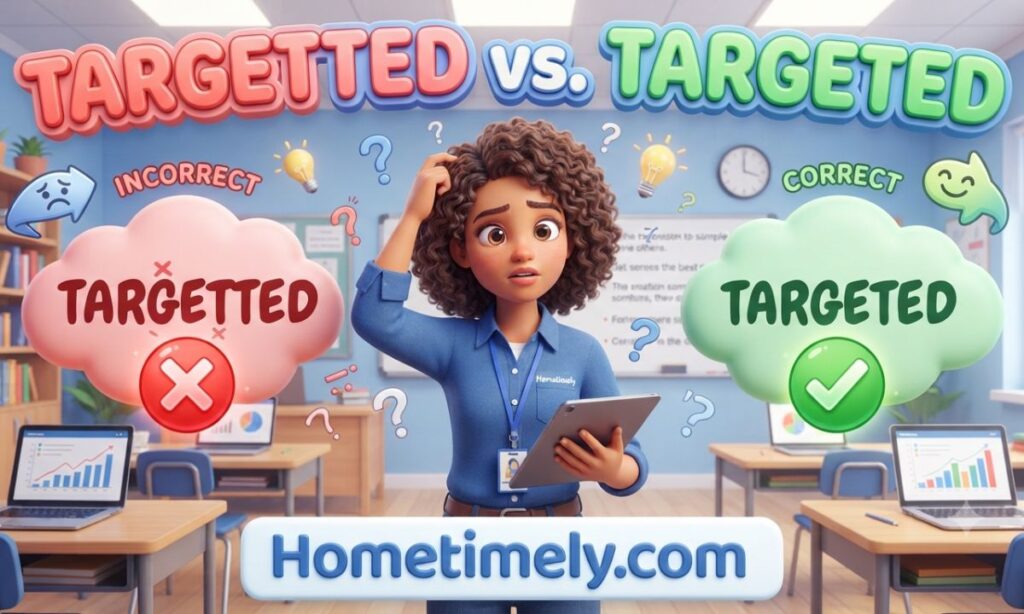
“Targeted” is the correct spelling. “Targetted,” with a double T, is always incorrect — in American English, British English, and every other English-speaking region.
- ✅ The campaign targeted young professionals.
- ❌ The campaign targetted young professionals.
There’s no regional variation here, no style-guide disagreement, and no context where the double-T version is acceptable. It’s simply a misspelling, and dictionaries and spell-checkers alike will flag it.
Meaning of “Targeted”
“Targeted” is the past tense and past participle of the verb target, which means to aim at, focus on, or direct something toward a specific goal, group, or object. It can also function as an adjective describing something that has been precisely aimed or directed.
As a verb:
- The company targeted college students with its new app.
- Cybersecurity teams targeted the source of the breach.
As an adjective:
- The ad relied on targeted marketing to reach the right audience.
- Doctors recommended a targeted treatment for the condition.
In both roles, “targeted” carries the same core idea: precision. It signals that something wasn’t random — it was chosen deliberately, with intention.
Why “Targetted” Is Incorrect
Here’s where the confusion actually comes from, and it has nothing to do with carelessness. It comes from a genuine English spelling pattern — just one that doesn’t apply here.
In English, some one-syllable or stress-final verbs double their last consonant before adding “-ed” or “-ing.” Think of:
- stop → stopped
- plan → planned
- regret → regretted
This happens when the final syllable is stressed and ends in a single consonant preceded by a single vowel. Since “target” looks like it follows that same consonant-vowel-consonant pattern, people naturally assume it needs the same treatment.
But “target” doesn’t qualify, for one key reason: the stress falls on the first syllable, not the last. We say TAR-get, not tar-GET. Because the stressed syllable isn’t at the end of the word, the doubling rule simply doesn’t apply. The correct form stays “targeted,” with a single T.
This is the same reason words like visit and enter don’t double their final consonant either:
- visit → visited (not “visitted”)
- enter → entered (not “enterred”)
- offer → offered (not “offerred”)
“Target” behaves exactly like these words, not like “stop” or “plan.” Once you see the pattern, “targetted” stops looking plausible altogether.
Simple Rule to Remember
Here’s the rule distilled into one line:
Double the final consonant only when the stress falls on the last syllable. If the stress is on an earlier syllable, don’t double it.
Applying that to “target”:
- Identify the stress: TAR-get (stress on the first syllable).
- Since the stress isn’t on the final syllable, no doubling occurs.
- Add “-ed” directly to the base word: target + ed = targeted.
That’s the entire logic. No exceptions, no regional quirks — just one consistent spelling rule.
Targeted vs Targetted Comparison Table
| Feature | Targeted | Targetted |
| Correctness | ✅ Correct in all English varieties | ❌ Incorrect everywhere |
| Recognized by dictionaries | Yes (Oxford, Merriam-Webster, Cambridge) | No |
| Used in formal/academic writing | Yes | Never appropriate |
| Consonant doubling | Not needed (stress on first syllable) | Incorrectly doubles the T |
| Spell-checker status | Passes | Flagged as an error |
| Example sentence | The offer was targeted at new members. | The offer was targetted at new members. ❌ |
Keep this table handy the next time you’re proofreading a document, and you’ll catch the mistake in seconds.
American vs British English Differences
Unlike many English word pairs — color/colour, traveling/travelling, organize/organise — “targeted” doesn’t split along American and British lines. Both varieties of English use the exact same single-T spelling.
| Region | Correct Spelling |
| American English | targeted |
| British English | targeted |
| Canadian English | targeted |
| Australian English | targeted |
This makes “targeted” refreshingly simple compared to other doubling-related words. For instance:
- “Travel” doubles the L in British English (travelling) but not in American English (traveling).
- “Target,” by contrast, never doubles its consonant in either variety.
If you’re writing for an international audience, you can use “targeted” without worrying about adjusting the spelling for different readers. It’s one less thing to second-guess.
Common Mistakes People Make
Even experienced writers slip up here from time to time. Below are the most frequent errors, along with quick corrections.
Mistake 1: Assuming all short verbs double their consonant
- ❌ They targetted the wrong demographic.
- ✅ They targeted the wrong demographic.
This is the root cause of almost every instance of “targetted.” Writers subconsciously apply the “stop → stopped” pattern without checking where the stress actually falls.
Mistake 2: Confusing “targeted” with “targeting”
- ❌ The team is currently targetted new leads.
- ✅ The team is currently targeting new leads.
“Targeted” is the past tense/past participle. “Targeting” is the present participle, used for ongoing action. They serve different grammatical roles and shouldn’t be swapped.
Mistake 3: Trusting autocorrect blindly
Some spell-checkers and browser extensions fail to catch “targetted,” especially in less rigorous tools. Never assume a red squiggly line (or the lack of one) is the final word — when in doubt, check a dictionary.
Mistake 4: Overcorrecting related words
Because “targeted” doesn’t double its consonant, some writers assume no verb ending in a consonant-vowel-consonant pattern ever doubles it. That’s not true either. Words like “committed,” “regretted,” and “admitted” do double their consonant, because their stress lands on the final syllable. The rule depends on stress placement, not just spelling shape.
Here’s a quick side-by-side to keep the pattern straight:
| Word | Stress | Past Tense | Doubles? |
| target | TAR-get | targeted | No |
| commit | com-MIT | committed | Yes |
| visit | VIS-it | visited | No |
| regret | re-GRET | regretted | Yes |
| offer | OFF-er | offered | No |
| admit | ad-MIT | admitted | Yes |
Notice the pattern: whenever the stress lands on the last syllable, the consonant doubles. Whenever it doesn’t, it stays single.
Quick Grammar Rule to Remember
If you want a shortcut that doesn’t require thinking about syllable stress every time, try this:
Target + ed = Targeted. One T stays one.
Or use this simple three-step check whenever you’re unsure about doubling a consonant in any word:
- Say the word out loud and find the stressed syllable.
- Check if that stressed syllable is the last one in the word.
- If yes, double the final consonant. If no, don’t.
Applying this to “target” (TAR-get) confirms, every single time, that the correct form is “targeted.”
Also Read Thsi : Visiter or Visitor: Which One Is Correct? (Answered in 30 Seconds)
Example Sentences Using “Targeted” Correctly
Seeing “targeted” in a variety of real-world contexts helps the correct spelling stick. Here are examples across different fields.
Marketing and Advertising
- The brand launched a targeted campaign aimed at Gen Z shoppers.
- Our targeted ads reached users based on browsing behavior.
Business and Strategy
- Leadership targeted three new markets for expansion this year.
- The company targeted small businesses with a discounted subscription tier.
Healthcare
- The treatment targeted the specific gene responsible for the disorder.
- Doctors recommended a targeted therapy instead of a general approach.
Cybersecurity
- Hackers targeted the company’s outdated login system.
- The security patch targeted a known vulnerability in the software.
Government and Policy
- Officials targeted high-risk neighborhoods for the vaccination drive.
- The new policy targeted reducing emissions in urban areas.
Everyday Conversation
- She targeted her savings goal for a summer trip.
- I targeted next Monday as my deadline.
Across every one of these examples, “targeted” communicates the same idea: something was chosen deliberately and aimed at with precision.
Synonyms and Related Words
If you want to vary your sentence structure or simply need an alternative word, several synonyms carry a similar meaning to “targeted.” Keep in mind that these words don’t always overlap perfectly, so choose based on context.
- Focused — The campaign was focused on younger audiences.
- Directed — The message was directed at first-time buyers.
- Aimed — The strategy was aimed at reducing costs.
- Selected — The company selected specific regions for testing.
- Intended — The offer was intended for loyal customers.
- Specific — The plan used specific criteria to reach the right group.
While these words can substitute for “targeted” in many sentences, none of them carry the exact same connotation of precision and intentional aim that “targeted” conveys — which is why it remains the preferred term in marketing, healthcare, and strategic contexts.
When Should You Use “Targeted”?
“Targeted” fits naturally into a wide range of writing situations. Here’s a breakdown of when it’s the right word choice.
As a Past-Tense Verb
Use “targeted” to describe a completed action — something that has already happened.
- The campaign targeted new subscribers last quarter.
As an Adjective
Use “targeted” to describe something that has been designed with a specific focus or audience in mind.
- This is a targeted approach to customer service.
In Professional and Academic Writing
“Targeted” is standard across business reports, academic papers, scientific writing, and formal communication. There’s no context — formal or informal — where “targetted” becomes acceptable, so you can use “targeted” confidently everywhere.
In Marketing and Advertising Language
This word shows up constantly in advertising contexts: targeted ads, targeted audience, targeted campaign. If you work in digital marketing, content strategy, or communications, getting this spelling right matters for your professional credibility.
In Everyday Writing
Even outside professional contexts texts, social posts, casual emails — “targeted” is still the only correct spelling. There’s no informal exception that allows the double T.
Memory Trick to Never Misspell It Again
If you want a foolproof way to remember this rule, try one of these tricks:
Trick 1: The “get” test
Break the word down: TAR + GET. Say it slowly and notice the stress lands on “TAR,” not “get.” Since the stress isn’t on the final syllable, there’s no reason to double the T.
Trick 2: Compare to “visit”
“Visit” never becomes “visitted.” Both words share the same stress-on-first-syllable pattern, so if “visited” looks obviously correct to you, “targeted” should too.
Trick 3: The formula
Picture this simple equation in your head:
Target + ed = Targeted (one T stays one T)
Trick 4: Spell-check confirmation
If you’re ever unsure while typing, most modern word processors and browsers will underline “targetted” in red. Trust that signal — it’s one of the few spelling errors that reliable spell-checkers catch consistently.
Whichever trick sticks with you, the underlying idea is the same: “target” behaves like “visit” and “enter,” not like “stop” and “plan.” Once that distinction clicks, you’ll never second-guess this word again.
Conclusion
At the end of the day, the difference between “targeted” and “targetted” comes down to a single, consistent rule: no doubling when the stress falls on the first syllable. “Targeted” is correct everywhere — in American English, British English, formal writing, and casual conversation alike. Keep the formula in mind — target + ed = targeted — and this spelling will never trip you up again.

Michael Brook is the creator and author behind Healthy Leeks, a platform focused on grammar, writing skills, and English language learning. Passionate about clear communication and effective writing, Michael Brook shares practical grammar tips, easy-to-follow language guides, and educational content to help readers improve their English with confidence.