
If you have ever stopped mid-sentence wondering whether to write worshipped or worshiped, you are not alone. This is one of English’s most quietly confusing spelling traps — not because the words differ in meaning, but because two major dialects of English handle the same verb in slightly different ways. One extra “p” can suddenly make perfectly correct writing look like a typo, and that uncertainty can shake your confidence as a writer.
The good news is this: once you understand the underlying pattern, the confusion disappears entirely. This guide covers the spelling rules, the grammar behind them, the religious meaning of the word, common mistakes writers make, and a full practice section so you can lock in the correct form for good.
The Core Difference Explained Clearly
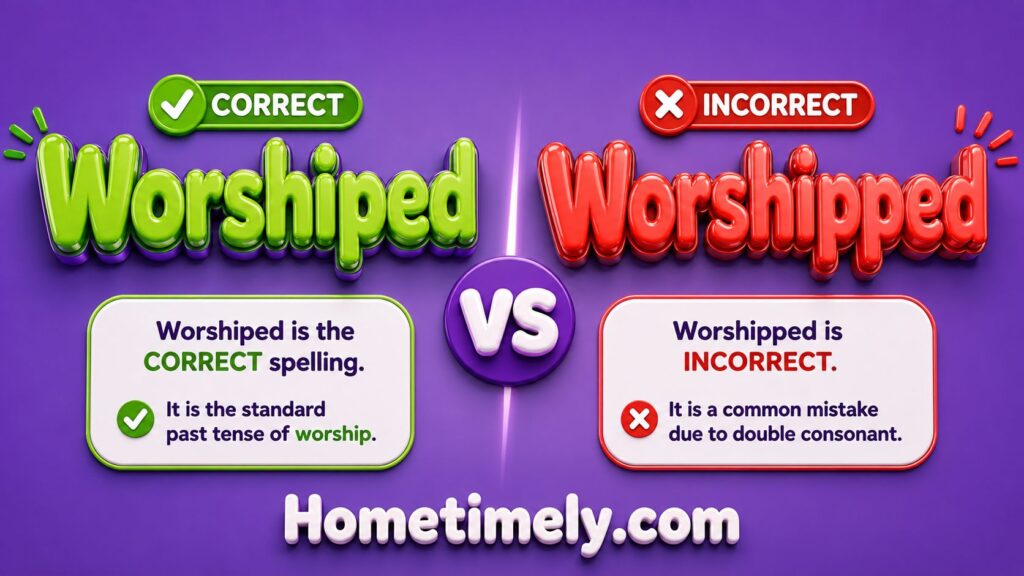
Both worshipped and worshiped are correct past tense forms of the verb worship. Neither spelling is wrong in absolute terms. The distinction is purely regional — one belongs to American English and the other to British English.
Comparison Table: Core Difference
| Feature | Worshiped | Worshipped |
| Spelling | Single “p” | Double “p” |
| Dialect | American English | British English |
| Meaning | Identical | Identical |
| Correctness | Fully correct | Fully correct |
| Example | “They worshiped at dawn.” | “They worshipped at dawn.” |
The core takeaway: the spelling you choose should match the dialect of your audience. The meaning never changes regardless of which form you use.
Worshipped vs Worshiped: Meaning and Usage
Before diving deeper into spelling rules, it helps to be clear on what the word actually means. Worship traces its roots to the Old English word weorþscipe, meaning worthiness, honor, or respect. Over centuries, the word evolved to describe acts of devotion directed at a divine being — prayer, ritual, reverence, and adoration. In modern everyday language, it has also expanded to describe intense admiration directed at a person, celebrity, idea, or even an institution.
To say someone is worshiped or worshipped means they have been given deep, often uncritical admiration or reverence. In religious contexts, it refers to being honored as a god or divine figure.
Meaning Breakdown Table
| Context | Sentence Example (American) | Sentence Example (British) |
| Religious | “The congregation worshiped God.” | “The congregation worshipped God.” |
| Cultural/figurative | “Fans worshiped the rock star.” | “Fans worshipped the rock star.” |
| Historical | “Ancient tribes worshiped the sun.” | “Ancient tribes worshipped the sun.” |
| Personal devotion | “He worshiped his mentor.” | “He worshipped his mentor.” |
In every case above, the meaning is exactly the same. The only variable is the number of “p”s.
The Grammar Behind Worshiped or Worshipped Spelling
To truly understand why two spellings exist, you need to look at a specific English grammar rule: consonant doubling before suffixes.
Grammar Rule Comparison Table
| Rule Aspect | British English | American English |
| Base word | worship (ends in -ip) | worship (ends in -ip) |
| Syllable stress | Unstressed final syllable | Unstressed final syllable |
| Consonant doubling | Applied (-pp-) | Not applied (-p-) |
| Past tense | worshipped | worshiped |
| Present participle | worshipping | worshiping |
| Reasoning | Traditional spelling conventions | Noah Webster’s simplification reforms |
The difference emerged largely in the 18th and 19th centuries when American lexicographer Noah Webster deliberately simplified many English spellings to reflect American pronunciation and create a distinct American linguistic identity. British English retained its older conventions, including the consonant-doubling rule for verbs ending in a vowel-plus-consonant pattern.
Understanding Verb Forms of Worship
Worship is a regular verb, meaning it follows standard rules for conjugation. The only variation across its verb forms is — again — whether you apply the British or American spelling convention.
Verb Forms Table
| Verb Form | American English | British English |
| Base / Infinitive | worship | worship |
| Present simple | worship / worships | worship / worships |
| Present participle | worshiping | worshipping |
| Past simple | worshiped | worshipped |
| Past participle | worshiped | worshipped |
| Noun form | worshiper | worshipper |
One important note: worshiped functions both as the simple past tense (“She worshiped daily”) and as the past participle (“The statue had been worshiped for centuries”). The same rule applies to the British form with double “p.”
Worshipping or Worshiping: American English vs British Usage
The present participle form — the -ing version — follows the exact same logic as the past tense. British English doubles the “p” to produce worshipping, while American English keeps it single to give worshiping. Both are grammatically valid.
Usage Comparison Table
| Usage Situation | Correct American Form | Correct British Form |
| “They were ___ at the temple.” | worshiping | worshipping |
| “The ___ crowd chanted prayers.” | worshiping | worshipping |
| A US academic paper | worshiping | — |
| A UK essay or publication | — | worshipping |
| A Commonwealth country (AU, NZ, CA) | — | worshipping |
| Global/neutral online content | Either (pick one, stay consistent) | Either |
The key principle for any writing project: pick one spelling and apply it consistently throughout the entire piece. Mixing worshipped in one paragraph with worshiping in the next creates an unprofessional impression that distracts readers.
Worship Meaning in Religious Contexts

In religious tradition across cultures, worship refers to any act of devotion, reverence, or homage offered to a deity, sacred object, or divine concept. It can take the form of prayer, sacrifice, ritual, song, silence, or community gathering. Worship is not limited to any single religion — the word applies across Christianity, Islam, Hinduism, Judaism, Buddhism, and indigenous spiritual traditions worldwide.
What makes worship distinct from ordinary respect or admiration is the element of submission: the worshiper recognizes the object of worship as higher than themselves, possessing divine or transcendent qualities.
Religious Context Table
| Religious Tradition | Form of Worship | Common Expression |
| Christianity | Prayer, hymns, communion | Worshiped in spirit and truth |
| Islam | Salat (five daily prayers) | Worship of Allah alone |
| Hinduism | Puja (ritual offerings) | Worshiped with incense and flowers |
| Judaism | Torah study, synagogue prayer | Worshiped the Lord of Israel |
| Buddhism | Meditation, offerings to Buddha | Revered rather than worshiped in many traditions |
| Indigenous traditions | Nature rituals, ancestor rites | Worshiped the earth and sky spirits |
Also Read This : Nonresponsive vs Unresponsive: Differences and Usage
Worship in the Bible: Meaning and Examples
The word worship appears hundreds of times in the Bible, though the exact spelling depends on the translation and the regional English standard it follows. British-based Bible versions, such as the King James Version and older editions, consistently use worshipped with double “p.” American editions and modern translations often use worshiped with a single “p.”
The original biblical texts were written in Hebrew, Aramaic, and Greek — not English. The choice of spelling is therefore always a translator’s decision based on their intended audience’s dialect.
Bible Usage Table
| Bible Version | Spelling Used | Example Verse Reference |
| King James Version (KJV) | worshipped | Genesis 22:5, Matthew 2:11 |
| New International Version (NIV – UK) | worshipped | John 4:20 |
| New International Version (NIV – US) | worshiped | John 4:20 |
| English Standard Version (ESV) | worshiped | Luke 4:8 |
| New Living Translation (NLT) | worshiped | Revelation 4:10 |
| English Heritage Version (EHV) | worshipped | Multiple passages |
One interesting historical note: researchers at the Wartburg Project found through Bryan Garner’s extensive computer surveys of published literature that worshipped with double “p” has actually been more common in American print than many dictionaries acknowledge — outranking single “p” by roughly a 3:1 ratio in some periods. This suggests the clean American vs. British divide is somewhat more blurred in actual usage than style guides imply.
Difference Between Worship and Praise
Worship and praise are closely related and often used in the same sentence, but they carry meaningfully different shades. Understanding the distinction helps you write with greater precision, especially in religious, theological, or devotional contexts.
Praise is the verbal or expressive acknowledgment of someone’s goodness, achievements, or qualities. It is outward-facing, celebratory, and can be directed at anyone — a friend, a teacher, an athlete, or God. Worship, by contrast, involves a deeper surrender of self. It is directed exclusively at the divine in most theological frameworks, and it requires humility, submission, and a recognition of the worshiper’s own smallness before the one being worshiped.
As one theological perspective puts it, praise is the joyful recounting of what God has done, while worship gets to the heart of who God is.
Comparison Table: Worship vs Praise
| Feature | Worship | Praise |
| Direction | Exclusively toward the divine | Can be toward anyone |
| Depth | Full submission and surrender | Acknowledgment and appreciation |
| Requirement | Spiritual humility | No spiritual requirement |
| Expression | Prayer, silence, ritual, lifestyle | Song, words, applause |
| Biblical example | “Worship the Lord your God” (Luke 4:8) | “Praise the Lord, all nations” (Psalm 117) |
| Everyday use | Rare outside religious contexts | Common in secular life |
A useful memory device: all worshipers praise, but not everyone who praises is worshiping. Worship encompasses praise, but praise alone does not constitute worship.
Worship vs Veneration and Idolatry
Three concepts that frequently get blurred in theological and philosophical writing are worship, veneration, and idolatry. Each has a distinct meaning, and confusing them leads to misrepresentation of religious traditions.
Worship (latria in Latin theological terms) is the highest form of devotion, reserved in most monotheistic traditions exclusively for God or the divine.
Veneration (dulia in Catholic theological usage) is deep honor and respect given to saints, holy figures, or sacred objects. It recognizes their holiness and spiritual role without equating them with God. The Catholic Church draws a careful distinction: honoring Mary or a saint is not the same act as worshiping God.
Idolatry is worship directed at something or someone who does not deserve it — a false god, a material object, or a human figure elevated to divine status. In the Abrahamic traditions, idolatry is explicitly forbidden.
Concept Comparison Table
| Concept | Target | Nature | Theological Status |
| Worship | God / the divine | Full submission, highest honor | Commanded in monotheism |
| Veneration | Saints, holy figures, icons | Deep respect and honor | Permissible in Catholic/Orthodox traditions |
| Idolatry | False gods, objects, persons | Misplaced divine-level honor | Forbidden in Abrahamic religions |
| Admiration | People, achievements | Appreciation and respect | Secular, no theological weight |
Common Mistakes with Worshipped vs Worshiped
Even experienced writers make predictable errors when working with this verb. Knowing the most common pitfalls helps you avoid them.
Mistake Comparison Table
| Mistake | Incorrect Form | Correct Form | Explanation |
| Mixing dialects | “He worshiped at dawn and they worshipped later.” | “He worshiped at dawn and they worshiped later.” | Stay consistent within one piece |
| Wrong tense entirely | “She worship yesterday.” | “She worshiped yesterday.” | Always use the past tense form |
| Assuming one is wrong | “Only worshipped is correct.” | Both are correct — dialect dependent | Neither spelling is an error |
| Applying US rule to UK writing | “The crowd worshiped the king.” (in a UK publication) | “The crowd worshipped the king.” | Match the spelling to your audience |
| Incorrect noun form | “The worshipper waited.” (in US writing) | “The worshiper waited.” | Noun follows the same single/double rule |
| Using worshiped for British Bible | “He worshiped God (KJV).” | “He worshipped God (KJV).” | Respect the source text’s regional standard |
Which Spelling Should You Use?
The decision is simpler than most writers think. It comes down to two factors: your audience and your style guide.
Decision Table
| Your Situation | Recommended Spelling |
| Writing for a US audience | worshiped, worshiping, worshiper |
| Writing for a UK / Commonwealth audience | worshipped, worshipping, worshipper |
| Following AP Style (journalism) | worshiped |
| Following Chicago Manual of Style (US) | worshiped |
| Quoting KJV or older British Bible | worshipped (preserve original) |
| Academic writing (UK university) | worshipped |
| Global blog or online content | Either — pick one and stay consistent |
| Not sure of audience | worshiped (more common in global search data) |
The single most important rule is consistency. Pick a form at the start of your document and never deviate from it. Inconsistency signals carelessness to editors, teachers, and discerning readers alike.
Worship Synonyms and Language Variety
English offers a rich range of synonyms for worship and worshiped, which can help you vary your writing, improve readability, and avoid repetitive use of the same word.
Synonym Table
| Word | Meaning / Nuance | Example |
| Revere | Deep respect with awe | “She revered her ancestors.” |
| Venerate | Honor as sacred or holy | “The monk venerated the relics.” |
| Adore | Love and worship deeply | “He adored the saint’s memory.” |
| Idolize | Worship to excess | “Fans idolized the singer.” |
| Exalt | Praise and lift up highly | “They exalted God’s name.” |
| Glorify | Magnify with honor | “The hymn glorified the Creator.” |
| Devote oneself to | Commit fully in worship | “She devoted herself to prayer.” |
| Pay homage to | Show formal reverence | “Citizens paid homage to the shrine.” |
The Grammar Behind Worshiped or Worshipped
The Consonant Doubling Rule
The core grammar question is: when does English double a final consonant before adding -ed or -ing? The standard rule in English is to double the final consonant only when:
- The verb ends in a single vowel followed by a single consonant, and
- The stress falls on the final syllable of the base word.
Travel → travelled (British) / traveled (American) Commit → committed (both dialects agree — stress is on the final syllable) Worship → Here is where the dialects disagree.
British English Rule
British English traditionally doubles the consonant in verbs ending in vowel + consonant, even when the final syllable is unstressed. Since worship ends in -ip (vowel + consonant), British English doubles the “p”:
- worship → worshipped, worshipping, worshipper
American English Rule
American English applies the rule more strictly: double the consonant only if the stress falls on the final syllable. In worship, the stress is on the first syllable (WOR-ship), so American English does not double the “p”:
- worship → worshiped, worshiping, worshiper
This explains why commit is committed in both dialects (stress on the final syllable -mit), but worship splits along dialect lines.
Grammar Rule Comparison Table
| Rule Component | British English | American English |
| Condition for doubling | Vowel + consonant ending | Vowel + consonant + final stress |
| Stress on worship | WOR-ship (first syllable) | WOR-ship (first syllable) |
| Doubles anyway? | Yes | No |
| Result | worshipped | worshiped |
| Same rule applies to | Travel → travelled | Travel → traveled |
| Agrees with each other on | commit → committed | commit → committed |
Practice Section
Fill in the Blanks (American English Focus)
Complete each sentence using the correct American English form of worship.
- Every Sunday, the community ________ at the local church.
- The ancient Egyptians ________ the sun god Ra.
- Thousands of fans had ________ the pop star for decades.
- He was raised in a family that ________ together every morning.
- The idol had been ________ for generations before it was discovered.
Answers Table
| Number | Correct Answer | Form Used |
| 1 | worshiped | Simple past |
| 2 | worshiped | Simple past |
| 3 | worshiped | Past participle |
| 4 | worshiped | Simple past |
| 5 | worshiped | Past participle |
Fill in the Blanks (British English Focus)
Complete each sentence using the correct British English form of worship.
- The congregation ________ in silence every Friday evening.
- Ancient Celtic peoples ________ at sacred groves in the forest.
- The relic had been ________ by pilgrims for five centuries.
- She ________ the memory of her grandmother with great tenderness.
- The temple where kings once ________ still stands today.
Answers Table
| Number | Correct Answer | Form Used |
| 1 | worshipped | Simple past |
| 2 | worshipped | Simple past |
| 3 | worshipped | Past participle |
| 4 | worshipped | Simple past |
| 5 | worshipped | Simple past |
Mixed Practice (Identify the Correct Form)
Choose the correct answer for each sentence based on the dialect specified.
- (American) The ancient tribe ________ the mountain as a god. [worshiped / worshipped]
- (British) She has ________ at this shrine since childhood. [worshiped / worshipped]
- (American) The band was ________ by millions of dedicated fans. [worshiped / worshipped]
- (British) They ________ together under the open sky. [worshiped / worshipped]
- (Global — either is acceptable) The pharaoh was ________ as a living god. [worshiped / worshipped]
Answers Table
| Number | Correct Answer | Reason |
| 1 | worshiped | American English — single “p” |
| 2 | worshipped | British English — double “p” |
| 3 | worshiped | American English — single “p” |
| 4 | worshipped | British English — double “p” |
| 5 | Either is acceptable | Global context — consistency matters |
Advanced Fill in the Blanks (Mixed Verb Forms)
Use the correct form of worship — past tense, present participle, or noun — as required by the sentence.
- The monk spent decades ________ in solitude. (present participle, British)
- He is a devoted ________ who attends service twice a week. (noun, American)
- The crowd was ________ the idol when the storm arrived. (past continuous, American)
- She had ________ nature long before she understood why. (past perfect, British)
- The ________ bowed deeply before the altar. (noun, British)
Answers Table
| Number | Correct Answer | Notes |
| 1 | worshipping | British present participle, double “p” |
| 2 | worshiper | American noun form, single “p” |
| 3 | worshiping | American present participle, single “p” |
| 4 | worshipped | British past perfect, double “p” |
| 5 | worshipper | British noun form, double “p” |
Final Mastery Drill
Identify the error (if any) in each sentence and write the corrected version.
- “In his UK article, he wrote that the Israelites worshiped the golden calf.”
- “The American congregation worshipped every Sunday morning.”
- “She is the most worshipped singer in the country.” (American publication)
- “He worship his parents every day of his life.”
- “Both worshipped and worshiped mean the same thing, so either is fine regardless of context.”
Answers Table
| Number | Error Present? | Correction / Explanation |
| 1 | Yes | UK article should use worshipped (double “p”) |
| 2 | Yes | American congregation should use worshiped (single “p”) |
| 3 | Yes | American publication should use worshiped (single “p”) |
| 4 | Yes | Wrong tense — should be worshiped (past) or worships (present) |
| 5 | Partially correct | Both mean the same — but “regardless of context” is misleading; choose based on your audience’s dialect |
Conclusion
The debate between worshipped and worshiped has a clean, satisfying answer: both are correct, neither is an error, and the choice comes down to which dialect you are writing in. Use worshiped for American English and worshipped for British, Australian, or Commonwealth English. The same logic extends to all related forms — worshiping vs worshipping, worshiper vs worshipper.
Beyond the spelling debate, worship itself is a word with deep roots — etymologically, theologically, and culturally. Whether it appears in a newspaper column, a religious text, a college essay, or an Instagram caption, understanding its layers makes you a more confident and precise user of English.
The golden rule for every writer: pick a spelling, know why you picked it, and stay consistent from the first word to the last.

Michael Brook is the creator and author behind Healthy Leeks, a platform focused on grammar, writing skills, and English language learning. Passionate about clear communication and effective writing, Michael Brook shares practical grammar tips, easy-to-follow language guides, and educational content to help readers improve their English with confidence.