
You are writing an email, finishing an essay, or typing a quick message, and suddenly you stop. Is it useing or using? You type one, delete it, type the other, and still feel unsure. That half-second of doubt is more common than you might think — and it is completely understandable.
English spelling is full of patterns that feel almost logical until one rule quietly overrides another. The confusion between useing and using is a perfect example of this. At first glance, keeping the “e” seems reasonable. After all, the base word is use, so why would you throw away a letter when adding a suffix? The answer comes down to one of English’s most consistent and useful spelling rules — one that, once you understand it, will help you spell dozens of other words correctly too.
This guide covers the correct spelling, the grammar rule behind it, the most common mistakes writers make, real sentence examples, a memory trick that actually works, and a complete look at how the same pattern applies across the broader family of -ing verbs in English.
Useing or Using: The Correct Spelling
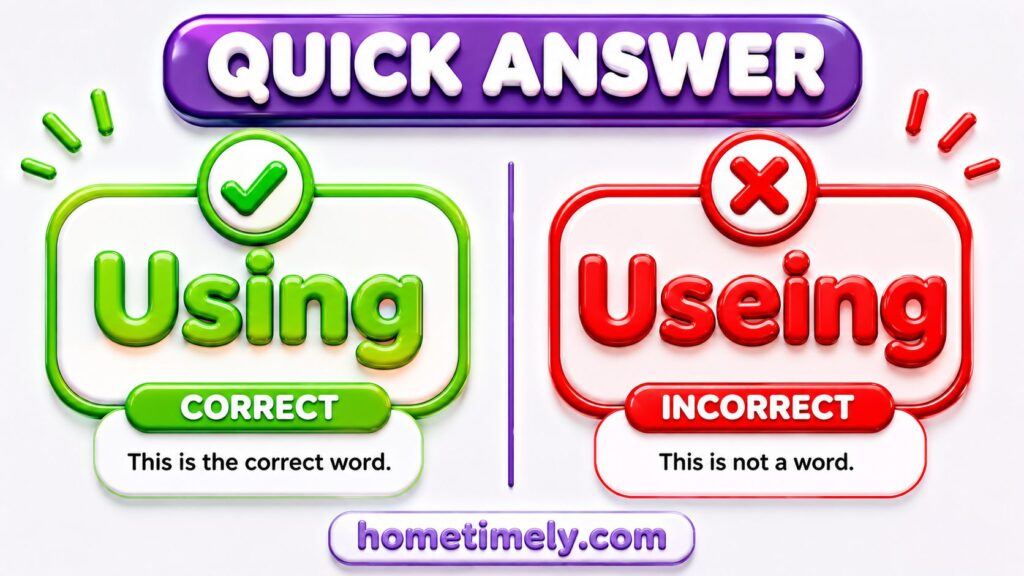
Let’s settle this immediately: using is the correct spelling. Useing is not a real English word. It has no dictionary entry, no recognized usage, and no correct context — not in academic writing, not in professional communication, not in casual text messages, and not anywhere else in standard English.
The reason useing looks tempting is that the base verb is use, which ends in the letter “e.” When you mentally attach -ing to use, the result feels like it should be useing. But English has a specific rule that prevents exactly this from happening — and following that rule produces using, every single time.
Correct example:
- “She is using her phone to navigate.”
- “They have been using the same software for years.”
- “Using proper grammar builds credibility.”
- “He started using a planner to stay organized.”
Incorrect example:
- ~~”She is useing her phone to navigate.”~~
- ~~”They have been useing the same software for years.”~~
- ~~”Useing proper grammar builds credibility.”~~
- ~~”He started useing a planner to stay organized.”~~
There is no regional variation here. Unlike some spelling differences between American and British English, this rule is universal. Both dialects of English spell the present participle of use the same way: using, with no “e” after the “s.”
Why “Useing” Is Incorrect
To understand why useing is wrong, you need to understand what linguists and grammar teachers call the silent “e” rule — also known as the drop-e rule or the magic e rule in elementary education.
Rule:
When a verb ends in a silent “e,” you must drop that “e” before adding a suffix that begins with a vowel — such as -ing, -ed, or -er.
The word use ends in a silent “e.” The letter “e” at the end of use does not make a sound when you say the word aloud. You do not say “yooz-ee.” The “e” is silent — its only job is to signal that the vowel before it (the “u”) makes a long sound.
Because “-ing” begins with the vowel “i,” the drop-e rule kicks in. You remove the silent “e” from use, leaving the root us, and then attach -ing directly. The result is using.
If you skip this step and leave the “e” in place, you create useing — a word with an unnecessary letter that violates standard English spelling conventions and gets flagged as an error by every spell-checker, grammar tool, and style guide in existence.
Similar examples:
| Base Verb | Incorrect -ing Form | Correct -ing Form |
| use | ~~useing~~ | using |
| make | ~~makeing~~ | making |
| write | ~~writeing~~ | writing |
| take | ~~takeing~~ | taking |
| have | ~~haveing~~ | having |
| give | ~~giveing~~ | giving |
| love | ~~loveing~~ | loving |
| come | ~~comeing~~ | coming |
| live | ~~liveing~~ | living |
| move | ~~moveing~~ | moving |
Every single verb in the right column follows the same drop-e rule. Useing fails for the exact same reason makeing or writeing would fail — the “e” should never be there.
How Do You Spell Using Correctly?
If you want a mechanical, foolproof method for producing the correct spelling every time, follow this three-step process.
Step-by-step:
- Start with the base verb: use
- Identify the silent “e”: The final letter “e” is silent — it does not produce a sound in the base word.
- Drop the “e” before adding -ing: Remove “e” from use → you are left with us → add -ing → using
That is all there is to it. Three steps, one correct result, zero exceptions for this word.
Formula:
use → drop the silent “e” → us + -ing = using
Or written as a general formula for all silent-e verbs:
[base verb ending in silent e] − e + -ing = correct present participle
Apply this formula to any of the verbs in the table above and you will arrive at the correct spelling every time. The logic never changes.
Common Mistakes With “Using”
Useing is the most obvious error, but writers make a few other predictable mistakes with this word and with similar -ing verb forms. Knowing what to watch for makes it easier to catch errors before they reach a reader.
Common incorrect forms:
- useing — keeping the “e” before adding -ing (most common mistake)
- usign — transposing the letters “i” and “g” (fast-typing error)
- ussing — doubling the “s” incorrectly (confusion with the consonant doubling rule)
- usng — dropping a vowel in casual or rushed typing
- use-ing — hyphenating the word unnecessarily
Correct form:
In every case above, the correct replacement is simply using — one word, no hyphen, no doubled letters, no retained “e.”
| Mistake | Type of Error | Correct Form |
| useing | Kept silent “e” before suffix | using |
| usign | Letter transposition | using |
| ussing | Applied wrong doubling rule | using |
| usng | Missing vowel | using |
| use-ing | Unnecessary hyphen | using |
The good news is that modern spell-checkers catch useing immediately and flag it in red. But spell-checkers are not always available — and even when they are, understanding why a word is wrong is far more valuable than simply accepting a machine’s correction.
Also Read This : Half Day vs Half-Day: Which Is Correct and How to Use Each Form
Examples of “Using” in Sentences

Seeing using in varied, natural contexts helps reinforce both its correct spelling and its grammatical flexibility. Using can function as a present participle in a progressive tense, as a gerund (a verb acting as a noun), or as part of an adverbial phrase.
Everyday examples:
As a present participle in progressive tenses:
- “She is using a new recipe for the dinner party.”
- “They were using GPS to find the shortest route.”
- “He has been using that old laptop for three years now.”
- “We will be using a different system starting next Monday.”
As a gerund (functioning as a noun):
- “Using social media wisely takes practice.”
- “Using the wrong tool can damage the surface.”
- “He believes using kind words costs nothing.”
- “Using data to make decisions is now standard practice.”
As part of an adverbial phrase (showing how something is done):
- “She fixed the shelf using only a screwdriver and two bolts.”
- “He wrote the letter using a fountain pen.”
- “They solved the problem using a creative approach.”
- “The artist painted the mural using recycled materials.”
In every one of these sentences, using carries the action of the verb use forward — describing an ongoing activity, naming an activity as a subject, or explaining the method behind an action. Not one of these sentences would accept useing as a substitute.
Why This Spelling Rule Matters
You might wonder whether a single misplaced “e” really matters in the big picture of communication. The honest answer is: yes, it does — more than most people realize.
Spelling accuracy affects how readers perceive your writing. When a word is misspelled, it creates a small but real interruption in the reading experience. The reader’s eye catches something unexpected, the brain pauses, and the flow of the message is disrupted. In professional writing — emails, reports, proposals, applications — that disruption can quietly undermine your credibility before you have even finished making your point.
Consider the contexts where using appears most frequently:
- Academic essays: Misspelling a foundational verb like using signals careless proofreading.
- Job applications and cover letters: Errors in basic vocabulary reduce confidence in a candidate’s communication skills.
- Business communication: Clients and colleagues expect polished, accurate language in professional correspondence.
- Content creation and publishing: Readers trust sources that demonstrate consistent language control.
None of this means a single typo ends a career or destroys a piece of writing. But when the correct spelling is this straightforward — and the rule this learnable — there is no reason to leave it to chance.
Easy Trick to Remember “Using”
Memory tricks, or mnemonics, are genuinely useful for locking in spelling rules that would otherwise keep slipping away. Here is one that works specifically for the drop-e rule and for using in particular.
Drop the silent “E”
Think of the silent “e” at the end of use as a guest who has to leave before the party starts. The party is the suffix -ing. The guest (the silent “e”) cannot stay once -ing arrives. So before you add -ing, you say goodbye to the “e.”
- The guest (e) leaves.
- The party (-ing) arrives.
- Result: using — not useing.
Another way to remember it: “The ‘e’ is silent, and silent guests don’t get to stay.”
You can apply this mental image to every verb that follows the same rule. Make drops its silent “e” for making. Write drops its silent “e” for writing. Use drops its silent “e” for using. Once the image clicks, the rule becomes instinctive.
A practical verification trick: say the base word out loud. If the final “e” makes no sound — if you say “yooz” not “yoo-zee” — then the “e” is silent, and it must be dropped before -ing.
Other Verbs That Follow the Same Rule
The drop-e rule is not limited to use. It applies consistently across a large family of English verbs — which means learning this one rule gives you the correct spelling for dozens of common words automatically.
| Base Verb | Drop the “e” | Add -ing | Correct Form |
| use | us | + ing | using |
| make | mak | + ing | making |
| take | tak | + ing | taking |
| write | writ | + ing | writing |
| ride | rid | + ing | riding |
| give | giv | + ing | giving |
| have | hav | + ing | having |
| come | com | + ing | coming |
| live | liv | + ing | living |
| love | lov | + ing | loving |
| move | mov | + ing | moving |
| lose | los | + ing | losing |
| close | clos | + ing | closing |
| hope | hop | + ing | hoping |
| believe | believ | + ing | believing |
| manage | manag | + ing | managing |
| confuse | confus | + ing | confusing |
| excite | excit | + ing | exciting |
| notice | notic | + ing | noticing |
| advise | advis | + ing | advising |
Every verb in this table follows the same logic. When you spot a verb ending in a silent “e” and you want the -ing form, drop the “e” first. The pattern never changes for standard cases.
How to Avoid Spelling Mistakes Like Useing
Knowing a rule and applying it consistently are two different things. Here are practical habits that help bridge the gap — especially for fast writers who rely on instinct more than rules.
Simple Prevention Steps
- Pause before adding -ing to any verb ending in “e.” That half-second pause is enough to trigger the rule.
- Read the word aloud after writing it. If the “e” makes no sound in the base word, it should not appear in the -ing form.
- Use spell-check as a safety net, not a crutch. Spell-checkers catch obvious errors, but understanding the rule means you make fewer errors in the first place.
- Proofread slowly. Rushing through a proofread is when words like useing slip through unnoticed.
- Learn five new drop-e verbs each week. Familiarity with the pattern makes it automatic.
- Write more, not less. The more you write and receive corrections, the faster the correct forms become instinctive.
A Memory Trick That Works
Here is a single sentence you can memorize that covers the rule completely:
“Before -ing walks in, the silent ‘e’ walks out.”
Write it on a sticky note. Put it near your workspace. Within a few days of applying it consciously, the rule will transfer to automatic memory — and you will never write useing again.
Alternatively, use this quick self-check question every time you add -ing to a verb:
Does the base verb end in a silent “e”? If yes — drop it.
That single question, answered honestly, prevents the mistake every time.
Understanding the Larger Pattern of -Ing Verbs
The drop-e rule is just one of three key spelling rules that govern how English verbs behave when -ing is added. Understanding all three gives you a complete picture of how present participles and gerunds are formed — and helps you avoid errors well beyond just using vs useing.
Rule One: Drop Silent E
When a verb ends in a silent “e,” drop the “e” before adding -ing.
This is the rule that explains using, making, writing, riding, and all the verbs in the table above. The “e” is not pronounced, so it serves no purpose once a vowel suffix (like -ing) is attached. Removing it keeps the word clean and readable.
Examples:
- use → using
- make → making
- write → writing
- close → closing
- believe → believing
Quick test: Say the base verb. Does the final “e” make any sound? No? Drop it before adding -ing.
Rule Two: Keep the E When It Makes a Sound
Not every word ending in “e” follows the drop rule. If the “e” makes an audible sound — meaning it contributes to the pronunciation of the word — it stays.
Examples:
- see → seeing (the double “e” makes the “ee” sound — nothing to drop)
- agree → agreeing (the final “e” contributes to the “ee” sound)
- be → being (the “e” is voiced)
- flee → fleeing
- free → freeing
In these cases, removing the “e” would destroy the vowel sound of the word itself, so the rule does not apply.
| Verb | Keep or Drop “e”? | -ing Form |
| see | Keep (e is voiced) | seeing |
| use | Drop (e is silent) | using |
| agree | Keep (e is voiced) | agreeing |
| make | Drop (e is silent) | making |
| flee | Keep (e is voiced) | fleeing |
| write | Drop (e is silent) | writing |
Rule Three: Double the Final Consonant When Needed
When a verb ends in a single vowel followed by a single consonant, and the stress falls on the final syllable, you double the final consonant before adding -ing.
This rule applies to verbs like run, sit, swim, stop, and begin — words where doubling the consonant prevents a change in the vowel sound.
Examples:
- run → running (not runing — the double “n” keeps the short “u” sound)
- sit → sitting (not siting — the double “t” keeps the short “i” sound)
- swim → swimming
- stop → stopping
- begin → beginning (two syllables, stress on the final syllable -gin)
- forget → forgetting (stress on the final syllable -get)
When NOT to double: If the stress falls on the first syllable, or if the verb ends in two consonants or two vowels before the final consonant, do not double.
- listen → listening (not lisstening — no doubling needed)
- open → opening (stress on first syllable)
- visit → visiting (stress on first syllable)
Grammar Rule Comparison Table
| Verb Type | Rule | Example Verb | Correct -ing Form |
| Ends in silent “e” | Drop the “e” | use | using |
| Ends in silent “e” | Drop the “e” | make | making |
| Ends in voiced “e” (double vowel) | Keep the “e” | see | seeing |
| Ends in single vowel + consonant, final stress | Double the consonant | run | running |
| Ends in single vowel + consonant, final stress | Double the consonant | begin | beginning |
| Ends in single vowel + consonant, first stress | Add -ing directly | listen | listening |
| Ends in -w, -x, or -y | Add -ing directly | play | playing |
| Ends in -ie | Change -ie to -y, add -ing | lie | lying |
These three rules together account for the vast majority of -ing spelling questions a writer will encounter. Master them as a set, and the guesswork of English present participle spelling largely disappears.
Conclusion
The answer to useing or using is clear, clean, and worth committing to memory: using is always correct, and useing is always wrong.
The reason is one of English grammar’s most reliable and widely-applicable rules: when a verb ends in a silent “e,” you drop that “e” before adding a vowel suffix like -ing. The base verb use ends in a silent “e.” Drop it. Add -ing. Arrive at using — every time, in every variety of English, in every context from a casual message to a published article.
What makes this lesson particularly valuable is that it extends far beyond a single word. Once you internalize the drop-e rule, you automatically know how to spell making, writing, taking, living, loving, moving, and dozens of other high-frequency English words correctly. One rule, one memory trick, and a handful of practice repetitions — that is all it takes to eliminate this category of spelling error from your writing permanently.The next time you reach for the -ing form of any verb ending in “e,” ask yourself one question: Is that “e” silent? If the answer is yes, let it go. Clean spelling, clearer communication, and more confident writing all follow naturally from that one small habit.

Michael Brook is the creator and author behind Healthy Leeks, a platform focused on grammar, writing skills, and English language learning. Passionate about clear communication and effective writing, Michael Brook shares practical grammar tips, easy-to-follow language guides, and educational content to help readers improve their English with confidence.


