You’re polishing your resume, writing a job application email, or updating your LinkedIn profile — and suddenly your fingers type “carrer.” You stop. You stare at the screen. Wait, is that right?
It isn’t. But you’re in excellent company. “Carrer” is one of the most searched spelling mistakes in the English language, showing up in cover letters, school assignments, and professional bios every single day. One missing letter quietly damages the credibility of otherwise strong writing.
This guide fixes that problem permanently. You’ll get the correct spelling, the full meaning of “career,” how it differs from related words like “job” and “carrier,” and a look at the career fields growing fastest in 2026 — all in one place.
Carrer vs Career: Which One Is Correct?
Let’s settle this immediately, no buildup needed.
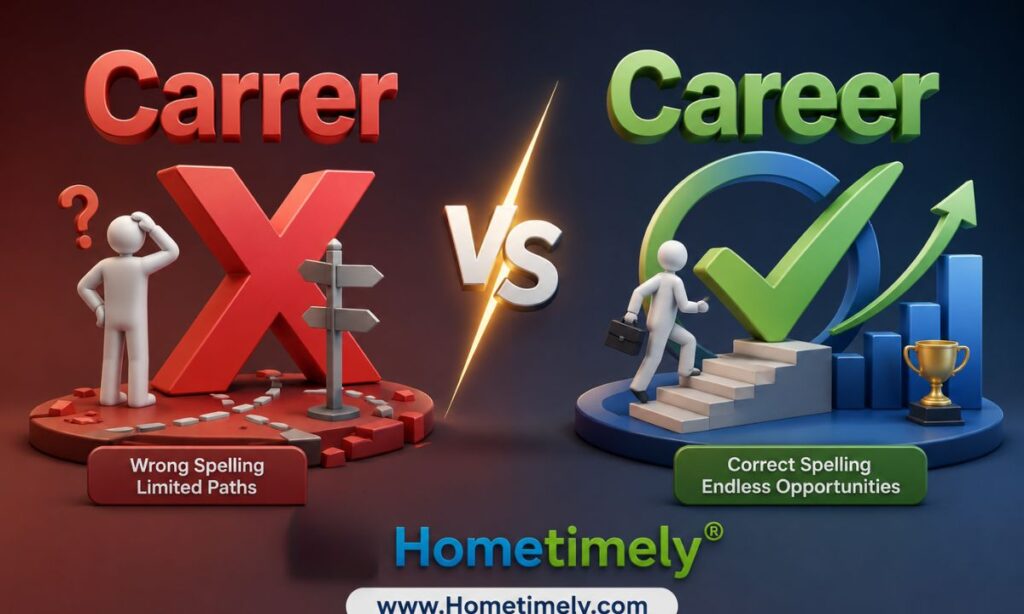
✅ Career — correct. A real English word found in every major dictionary. ❌ Carrer — incorrect. Not a word in standard English. It has no recognized meaning and no accepted usage in formal or informal writing.
The correct spelling is C-A-R-E-E-R. Two E’s in the middle — that’s the detail most people miss when typing quickly.
The word “career” comes from the French carrière, meaning a road or racecourse, which evolved into its modern meaning of a professional path or long-term occupation. There is no British vs. American spelling variation here. Whether you’re writing in the UK, US, Canada, or Australia, the spelling is always career.
Quick Spelling Reference Table
| Word | Correct? | Meaning |
| Career | ✅ Yes | Long-term professional journey or occupation |
| Carrer | ❌ No | A misspelling — not a real English word |
| Carreer | ❌ No | Another common misspelling — still wrong |
| Carrier | ✅ Yes | Something/someone that transports or carries |
| Curtsy | ✅ Yes | A bowing gesture (unrelated to career) |
Career Meaning: What the Word Actually Represents
A career is far more than a job title. At its core, a career is the long-term professional path a person builds over the course of their working life — involving education, skill development, roles held, promotions earned, and the overall direction of their professional growth.
According to Merriam-Webster, a career is “an occupation undertaken for a significant period of a person’s life and with opportunities for progress.”
Think of it this way: a career is the entire road. Individual jobs are the stops along that road. A person might work as a junior designer, then a senior designer, then a creative director — those are three different jobs, but together they form one career in design.
Career also functions as an adjective in English:
- A career politician — someone who has made politics their full-time professional focus
- A career-defining moment — a turning point that shapes a person’s professional future
And in rare usage, it functions as a verb meaning to move at high speed in an uncontrolled way: “The car careered down the hill.” This verb usage is unrelated to professional life.
Why “Carrer” Is Incorrect and Why People Still Use It
“Carrer” doesn’t exist in the English language, yet it appears constantly online. Why?
Two Key Reasons People Misspell “Career”
1. Typing speed and dropped vowels When writing quickly, the second “e” in “career” is easy to skip. The word moves fast under the fingers: C-A-R-E-E-R. That double vowel sits in the middle and disappears in a keystroke. Most people don’t even notice until spellcheck (if it catches it at all) flags the error.
2. Pronunciation leads the spelling astray “Career” can sound compressed when spoken quickly — almost like “care-er” — which gives some writers the impression that fewer letters are involved. In English, pronunciation and spelling don’t always align, and “career” is a clear example of that gap.
There’s one more contributing factor worth noting: in some other languages, particularly Catalan and Spanish dialects, carrer actually means “street.” This creates a cross-language confusion that shows up in writing, especially from multilingual speakers.
Example in Context
❌ “She built an impressive carrer in finance over 20 years.” ✅ “She built an impressive career in finance over 20 years.”
One extra “e” makes the difference between sloppy and sharp.
Career vs Job: Understanding the Real Difference
Many people use “career” and “job” as if they mean the same thing. They don’t — and mixing them up suggests a shallow understanding of both words.
A job is a position or set of duties performed to earn money. It is often short-term, task-focused, and not necessarily tied to a larger professional goal.
A career is a focused, long-term path a person builds through accumulated experience, intentional development, and professional growth. A career can consist of many jobs along the way.
All careers begin as jobs — but not all jobs lead to a career. The difference lies in intent, commitment, and direction.
Career vs Job Comparison Table
| Feature | Job | Career |
| Duration | Short to medium term | Long-term |
| Focus | Earn income now | Build expertise over time |
| Growth | Limited or none | Continuous upward progression |
| Motivation | Financial need | Purpose, skill, advancement |
| Planning | Minimal required | Deliberate and strategic |
| Example | Cashier at a store | Path from cashier → retail manager → operations director |
A Broader Perspective
A helpful way to think about it: you might hold many jobs throughout your life, but they all feed into one or two careers. Choosing to pursue a career — rather than just a series of jobs — requires decisions about education, training, and long-term professional direction.
Career vs Carrier: Avoiding Another Common Mistake
Beyond the “carrer” typo, there’s a second confusion worth addressing: career and carrier. These two words look similar but mean entirely different things.
Career = a person’s long-term professional path or occupation. Carrier = something or someone that transports, transmits, or carries.
The word “carrier” derives from the verb to carry. It can refer to a company that transports goods, a telecommunications provider, a person who carries a disease without being sick themselves, or a physical object used to carry things (like a bag or a bicycle carrier).
It has nothing to do with a job or profession.
Career vs Carrier Difference Table
| Word | Meaning | Example |
| Career | Long-term professional journey | She has a successful career in law. |
| Carrier | Entity that transports or transmits | The mobile carrier upgraded its network. |
| Carrier (biology) | Person/organism transmitting disease | She was an asymptomatic carrier of the virus. |
| Carrier (logistics) | Company/vehicle moving goods | The shipping carrier delivered the package. |
A Less Obvious Confusion
Some people type “carrier” when they mean “career” in professional writing — for example, “I want to build a strong carrier in technology.” That sentence makes no grammatical sense in context. The correct word is always career when discussing professional development.
Career Path Meaning and Growth Explained
A career path refers to the sequence of jobs, roles, and experiences that advance a person toward their professional goals. It’s the route, not just the destination.
A well-planned career path typically includes:
- A clear long-term professional goal
- Identification of required skills and qualifications
- Entry-level roles that build foundational experience
- Progressive advancement through increasingly senior positions
- Continuous learning, upskilling, and adaptation
Career paths aren’t always linear. Many professionals pivot into adjacent fields, change industries entirely, or circle back to earlier interests with new skills. What matters is intentional movement — not a perfectly straight line.
Career vs Work, Employment, and Business
These terms often overlap in casual conversation, but each carries a distinct meaning:
| Term | Meaning |
| Career | Long-term professional journey in a chosen field |
| Work | General term for tasks done, paid or unpaid |
| Employment | The formal state of being hired by an employer |
| Occupation | The specific type of work a person does |
| Business | A commercial enterprise or self-owned venture |
| Profession | A career requiring specialized training/certification |
Career Examples Across Different Fields
The word “career” applies across every professional domain. Here are career examples by field:
- She built a 25-year career in nursing, eventually becoming a hospital administrator.
- His career in software engineering started with a single internship at a startup.
- After a decade-long career in teaching, she transitioned into educational policy.
- He pursued a career in finance, moving from analyst to portfolio manager over 15 years.
- Her career in journalism took her from local news to international broadcasting.
How to Build a Career Step by Step
Whether you’re just starting out or considering a pivot, building a career is a deliberate process. Here’s how most successful professionals approach it:
- Identify your interests and strengths — What subjects energize you? What skills come naturally? A career aligned with genuine interest sustains long-term motivation.
- Research your target field — Understand what education, certifications, and experience the field requires. Talk to professionals already working in it.
- Get qualified — Pursue relevant degrees, diplomas, certifications, or bootcamps. Formal education isn’t the only path, but credentials matter in many fields.
- Gain early experience — Internships, volunteer roles, freelance work, and entry-level positions all build the experience foundation your career stands on.
- Build your professional network — Up to 75–80% of jobs are filled through connections. Networking — online and in person — is not optional; it’s strategic.
- Keep developing your skills — The professional landscape changes fast. Continuous upskilling, especially in technology, keeps you relevant and competitive.
- Set career milestones — Vague goals produce vague results. Define specific targets: roles you want to hold, skills you want to master, and timelines to achieve them.
Top Career Fields That Will Boom in 2026
If you’re planning a career move or choosing a field for the first time, the job market in 2026 is generating strong opportunities in several key sectors.
Healthcare, technology, and digital marketing remain among the top career fields with the strongest growth and long-term demand.
According to the Bureau of Labor Statistics, healthcare leads with 8.4% job growth through 2034 — far outpacing the national average of 3.1% — while roles like information security analysts project a 29% increase.
Here’s a snapshot of the hottest career fields right now:
| Career Field | Why It’s Growing | Key Roles |
| Artificial Intelligence | AI adoption across all industries | AI engineer, ML specialist, prompt engineer |
| Healthcare | Aging global population, rising demand | Nurse practitioner, physician assistant, health informatics |
| Cybersecurity | Increasing data breaches and digital threats | Security analyst, ethical hacker, cloud security engineer |
| Renewable Energy | Government and corporate sustainability goals | Solar technician, wind turbine engineer, sustainability analyst |
| Data Science | Data-driven decision-making across sectors | Data analyst, data engineer, business intelligence specialist |
| Digital Marketing | Shift of commerce and media to online platforms | SEO specialist, content strategist, performance marketer |
| Mental Health | Growing awareness and reduced stigma | Therapist, counselor, behavioral health specialist |
Demand for nurses, physical therapists, and mental health professionals is increasing due to an aging population, and sustainability and renewable energy careers are booming as companies go green.
Practice Session: Carrer vs Career
Fill in the Blanks
Complete each sentence with the correct word (career / carrer):
- She has worked hard to build a ______ in international law.
- He made a bold decision to change his ______ at age 40.
- Good education lays the foundation for a strong ______.
- A ______ in technology often starts with a computer science degree.
- Never write “______” on a resume — it doesn’t exist in English.
(Answers: 1. career, 2. career, 3. career, 4. career, 5. carrer — as the incorrect example)
Multiple Choice Questions
Q1. Which spelling is correct?
- A) Carrer
- B) Career
- C) Carreer
Q2. What does “career” mean?
- A) A short-term job
- B) A long-term professional journey
- C) A mode of transportation
Q3. Which sentence is written correctly?
- A) He built a strong carrer in marketing.
- B) He built a strong career in marketing.
- C) He built a strong carreer in marketing.
Q4. What is the difference between a career and a carrier?
- A) They mean the same thing
- B) Career = profession; Carrier = something that transports
- C) Career = transport; Carrier = profession
Q5. Which is NOT a correct usage?
- A) Career path
- B) Career goals
- C) Carrer development
Answers
| Question | Correct Answer |
| Q1 | B — Career |
| Q2 | B — Long-term professional journey |
| Q3 | B — He built a strong career in marketing |
| Q4 | B — Career = profession; Carrier = something that transports |
| Q5 | C — “Carrer development” is wrong; correct is “Career development” |
Expert Tip: How Recruiters Spot Careless Writing Instantly
Here’s something most job seekers don’t know: hiring managers and recruiters are trained to spot writing errors fast. When a resume or cover letter contains a misspelling — especially one as avoidable as “carrer” — it signals more than a typo. It signals a lack of attention to detail.
What They Look For
Recruiters scanning dozens of applications in a single sitting are pattern-matching for professionalism. A single spelling error doesn’t just get flagged — it gets you filtered out. Here’s why this particular mistake is especially damaging:
- It appears in high-visibility locations — The word “career” tends to appear in headlines like “Career Objective” or “Career Summary” — the very first things a recruiter reads.
- It suggests the document wasn’t proofread — If “career” is misspelled, what else might be wrong?
- It undermines your professional image — In competitive job markets, presentation matters as much as qualifications.
The fix is simple:
- Always run spellcheck — but don’t rely on it alone, because some tools miss “carrer” if context is unclear
- Read your resume aloud before sending it
- Have a second person review it
- Search and replace “carrer” with “career” in any document before submitting
One extra “e” is the difference between looking polished and looking careless..
Frequently Asked Questions
Is “carrer” a real word?
No. “Carrer” is a misspelling of “career” and has no meaning in standard English.
How do you spell career correctly?
The correct spelling is C-A-R-E-E-R — two E’s in the middle.
What does career mean?
A career is a person’s long-term professional path or occupation, built over time through experience and development.
Is the spelling different in British and American English?
No. Both use the same spelling — “career” — with no regional variation.
What is the difference between career and carrier?
Career refers to a professional journey; carrier refers to something or someone that transports or transmits.
What is a career path?
A career path is the sequence of roles and experiences that progressively advance a person toward their professional goals.
Can career be used as a verb?
Yes, but rarely — it means to move at high speed out of control, e.g., “The car careered off the road.” It’s unrelated to professional life.
What is the difference between a career and a job?
A job is a single position held for income; a career is the entire long-term professional journey that may include many jobs.
Conclusion
The answer to “carrer vs career” is simple and absolute: career is correct. Carrer is not a word in the English language — it’s a typo that has become one of the most common spelling errors in professional writing.
Spell it C-A-R-E-E-R, every single time, in every context, across every version of English. There are no exceptions, no regional variations, and no situations where “carrer” becomes acceptable.
Beyond the spelling, understanding what “career” truly means — a long-term professional journey built through intention, effort, and continuous growth — gives you a sharper lens for planning your own path. Whether you’re choosing a first career, navigating a change, or simply writing a better resume, getting this word right is the smallest step that makes the biggest impression

Michael Brook is the creator and author behind Healthy Leeks, a platform focused on grammar, writing skills, and English language learning. Passionate about clear communication and effective writing, Michael Brook shares practical grammar tips, easy-to-follow language guides, and educational content to help readers improve their English with confidence.


