
Have you ever typed “batchelor degree” on your resume and second-guessed yourself halfway through? You are not alone. The bachelor vs batchelor debate is one of the most searched spelling questions in English — and for good reason. Both versions look almost identical at first glance, and the way the word sounds makes the wrong spelling feel completely natural.
Here is the truth: only one of them is correct. And getting it wrong on a resume, a university application, or a professional email can quietly cost you credibility before anyone reads the rest of your writing.
This guide breaks down everything — the correct spelling, both meanings of the word, how the grammar works, and practical exercises to lock it all into memory.
Quick Answer: Bachelor vs Batchelor
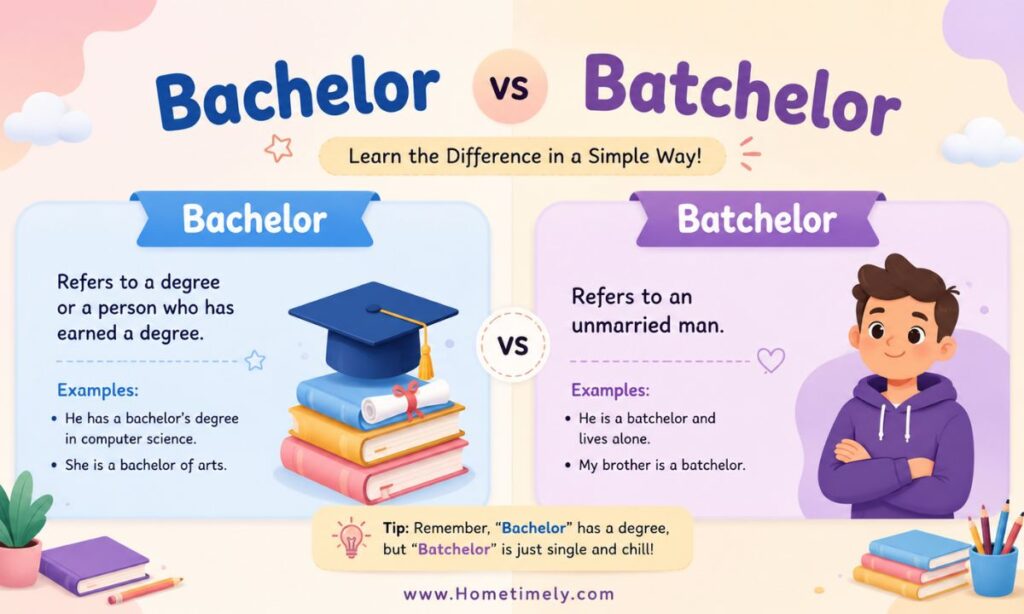
Bachelor is the correct spelling. It refers to an unmarried man or an undergraduate academic degree.
Batchelor is not a standard English word. It is almost always a spelling error — the only exception is when it appears as a proper noun, such as a surname (e.g., John Batchelor, the British broadcaster).
One rule to remember: No “T” in bachelor.
Why This Confusion Persists
The confusion is not carelessness — it is phonetics. When you say the word out loud, the “ch” makes a soft sound that naturally pushes the tongue toward a “t” before it. Your brain fills in a letter the word never had.
Other contributing factors include:
- Similar-looking words like “bachelor” and “batch” both being real English words
- Autocorrect sometimes failing to flag the misspelling
- Older or informal texts where “batchelor” occasionally appeared
- Non-native English speakers relying on pronunciation rather than spelling rules
Even well-educated writers make this mistake. The key is knowing why it happens — that awareness alone dramatically reduces the error.
Clear Comparison
| Feature | Bachelor | Batchelor |
| Correct spelling | ✅ Yes | ❌ No |
| Standard English word | ✅ Yes | ❌ No |
| Refers to unmarried man | ✅ Yes | ❌ Incorrect usage |
| Refers to academic degree | ✅ Yes | ❌ Incorrect usage |
| Used as a surname | Rarely | ✅ Yes (proper noun only) |
| Accepted in dictionaries | ✅ Merriam-Webster, Oxford | ❌ Not listed |
| Acceptable in formal writing | ✅ Always | ❌ Never (unless a name) |
Bachelor Meaning: Definitions Across Contexts
Bachelor Definition in English
According to Merriam-Webster, a bachelor is defined as:
- A person who has received a degree from a college or university, typically after completing an undergraduate course of study
- An unmarried man, especially one past the typical age of marriage
The word traces back to the Old French bacheler, meaning a young man or apprentice knight. By the medieval period, it evolved to describe someone at the lowest rung of academic or military achievement — a starting point before advancement.
Bachelor as an Unmarried Man
In everyday language, a bachelor refers to a man who has never married. The term carries a social connotation — often suggesting freedom, independence, and a single lifestyle.
Common usage in this sense includes:
- He has been a confirmed bachelor his whole life.
- The party celebrated his last night as a bachelor.
- She had always been drawn to eligible bachelors.
It is worth noting that bachelor traditionally refers to men. The female equivalent in American English is bachelorette. In older British English, the term spinster was used, though it now carries negative connotations and is largely avoided in modern writing.
Bachelor in Relationships and Pop Culture
The word bachelor has taken on a life of its own in modern culture. Reality TV shows like The Bachelor and The Bachelorette turned the term into mainstream entertainment, reinforcing its association with dating, romance, and marriage decisions.
In everyday conversation, calling someone an “eligible bachelor” still signals that they are single, attractive, and desirable. The cultural weight of the word extends far beyond grammar.
Bachelor Degree Explained: Academic Meaning and Structure
What Is a Bachelor Degree?
A bachelor’s degree is an undergraduate academic qualification awarded by colleges and universities, typically after three to four years of full-time study. It is the most common first degree pursued after secondary school and serves as the foundation for most professional careers and advanced graduate study.
The term originated from the medieval university system, where bachelor described a student who had completed the lowest level of academic training — much like a young apprentice in a trade.
Undergraduate Degree Meaning
A bachelor’s degree sits at the undergraduate level — below a master’s degree and doctoral degree, but above a diploma or associate degree. It signals that a student has completed a structured course of academic or professional training in a recognized field.
Types of Bachelor Degrees
| Degree | Full Name | Common Fields |
| BA | Bachelor of Arts | English, History, Psychology |
| BS / BSc | Bachelor of Science | Biology, Chemistry, Physics |
| BBA | Bachelor of Business Administration | Business, Finance, Marketing |
| BFA | Bachelor of Fine Arts | Art, Design, Film, Theatre |
| BEd | Bachelor of Education | Teaching, Curriculum Studies |
| BEng | Bachelor of Engineering | Civil, Mechanical, Electrical |
| BN / BSN | Bachelor of Nursing | Nursing, Healthcare |
| LLB | Bachelor of Laws | Law |
Bachelor Degree Abbreviation
The standard abbreviations for bachelor’s degrees are:
- BA or B.A. — Bachelor of Arts
- BS or B.S. — Bachelor of Science (American English)
- BSc or B.Sc. — Bachelor of Science (British English)
- BBA — Bachelor of Business Administration
- BFA — Bachelor of Fine Arts
AP style favors no periods (BA, BS). Chicago style and most academic institutions prefer periods (B.A., B.S.). Always apply one style consistently across a document.
Bachelor vs Bachelor’s: Understanding the Grammar
Difference Between Bachelor and Bachelor’s
This is where many writers stumble — even after getting the spelling right.
| Form | Example | When to Use |
| Bachelor | Bachelor of Arts | Formal degree title |
| Bachelor’s | I earned my bachelor’s degree | Informal reference to the degree |
| Bachelors | Three bachelors applied | Plural noun (multiple people) |
Possessive Form of Bachelor
Bachelor’s degree uses an apostrophe because the degree belongs to the bachelor — it is a possessive construction rooted in historical usage. In old English, the degree was literally “the degree of the bachelor,” which contracted over time into “bachelor’s degree.”
- ✅ She holds a bachelor’s degree in economics.
- ❌ She holds a bachelors degree in economics.
- ✅ He completed his Bachelor of Science. (formal title, capitalized)
- ✅ He has a bachelor’s in engineering. (informal reference, lowercase)
The apostrophe is not optional — omitting it is a grammatical error that appears frequently on resumes and job applications, and it is one reason recruiters pay close attention to this detail.
How to Spell Bachelor Correctly
How to Spell Bachelor?
The correct spelling is: B – A – C – H – E – L – O – R
There is no “T” anywhere in the word. The letters flow directly from “bach” to “elor” — no stop in between.
A simple memory trick: think of the word “bachelor” as containing the word “ache” — b-ACHE-lor. That internal word has no T, and neither does bachelor.
Why Is Bachelor Spelled Without “T”?
The word descends from Old French bacheler and Latin baccalarius, neither of which contained a “T” at that position. English inherited the spelling directly from these roots. The “t” that many people add is purely phonetic — the spoken sound suggests it, but the written form has never included it in standard usage.
Batchelor Meaning: Clarifying the Misconception
What Is the Meaning of Batchelor?
On its own, batchelor has no meaning as a standard English word. It does not appear in Merriam-Webster, Oxford, or Collins dictionaries as an accepted entry.
It exists in two narrow legitimate contexts:
- As a surname — John Batchelor is a well-known British radio broadcaster. The Batchelor surname appears in various historical records in the UK.
- In historical documents — Some very old texts used variant spellings before English orthography was standardized. These are archaic and should never be replicated in modern writing.
Is Batchelor a Word?
No — not as a common noun. In every context involving an unmarried man or an academic degree, batchelor is a misspelling. It is not recognized in any major modern dictionary as a standard entry.
Why People Write Batchelor
The three main reasons people write “batchelor”:
- Phonetic influence — The spoken word sounds like it has a “t” before the “ch”
- Association with “batch” — A real English word that creates false pattern recognition
- Lack of spell-check — Autocorrect does not always catch it, especially in casual writing environments
Practical Usage: How to Use Bachelor in a Sentence
Examples of Bachelor in Sentences
Referring to marital status:
- My brother is still a bachelor at thirty-five and perfectly happy.
- The film follows an eligible bachelor navigating life in New York.
Referring to academic degrees:
- She graduated with a bachelor’s degree in computer science.
- He is pursuing a Bachelor of Business Administration.
- The position requires a minimum of a bachelor’s degree.
Professional Usage
In professional writing — resumes, cover letters, LinkedIn profiles, and academic applications — precision matters. Below are examples of correct and incorrect usage:
| Context | Incorrect | Correct |
| Resume | Batchelor of Arts, 2022 | Bachelor of Arts, 2022 |
| Cover letter | I hold a bachelors degree | I hold a bachelor’s degree |
| Batchelor’s in Marketing | Bachelor’s in Marketing | |
| Job posting | Requires batchelor degree | Requires a bachelor’s degree |
The Impact of a Simple Spelling Error
Consider two job candidates with identical qualifications. Candidate A writes “Bachelor of Science” on their resume. Candidate B writes “Batchelor of Science.” Candidate A gets the interview. It sounds harsh — but research consistently shows that spelling and grammar errors on professional documents signal reduced attention to detail.
In academic submissions, misspelling the very credential you are applying for can raise immediate red flags. One misplaced letter carries more weight than most people realize.
Bachelor Party Meaning and Context
What Is a Bachelor Party?
A bachelor party is a celebration held for a man before his wedding — traditionally his “last night of freedom” as an unmarried man. Known in the UK and Australia as a stag do or stag night, the event usually involves close friends and often takes the form of an evening out, a trip, or an activity experience.
Bachelor Party Ideas
Popular bachelor party formats include:
- Weekend trips to cities like Las Vegas, Nashville, or Miami
- Outdoor activities — hiking, go-karting, paintball, or golf
- Private dinners, bar crawls, or club nights
- Escape rooms, cooking classes, or sporting events
The term “bachelor” in this context always refers to the groom-to-be — an unmarried man on the cusp of marriage.
Bachelor vs Master Degree: Key Differences
Comparison Table
| Feature | Bachelor’s Degree | Master’s Degree |
| Level | Undergraduate | Postgraduate |
| Duration | 3–4 years | 1–2 years |
| Entry requirement | High school diploma | Bachelor’s degree |
| Focus | Broad foundational study | Specialized advanced study |
| Common abbreviations | BA, BS, BBA | MA, MS, MBA, MEd |
| Career entry | Most entry-level positions | Senior or specialized roles |
A master’s degree builds directly on the foundation of a bachelor’s — it is the natural next step for professionals seeking specialization or career advancement.
Bachelor Degree vs Diploma
A diploma is a shorter, more skills-focused qualification — typically one to two years. A bachelor’s degree is broader, longer, and more academically rigorous. Most professional licensing bodies and universities require a bachelor’s degree for admission to graduate programs, whereas a diploma may qualify holders for specific technical roles.
Capitalization Rules: Is Bachelor Capitalized?
Is Bachelor Capitalized?
The rule is straightforward:
- Capitalize when referring to the full formal degree title: Bachelor of Arts, Bachelor of Science in Nursing
- Lowercase when used as a general reference: She has a bachelor’s degree, He completed his bachelor’s in finance
This follows standard English capitalization rules — proper nouns and formal titles take capitals; general references do not.
Examples:
- ✅ She holds a Bachelor of Arts from Oxford.
- ✅ He earned his bachelor’s degree last spring.
- ❌ She holds a bachelor of arts from Oxford. (formal title must be capitalized)
- ❌ He earned his Bachelor’s Degree last spring. (general reference should be lowercase)
Common Spelling Mistakes and Language Precision
Common Errors Include:
- Writing batchelor instead of bachelor
- Writing bachelors degree instead of bachelor’s degree (missing apostrophe)
- Capitalizing bachelor’s degree when used as a general reference
- Lowercasing Bachelor of Science when it appears as a formal title
- Using batchelor as if it were an alternative spelling — it is not
Statistics and Search Trends (2025–2026)
Interesting Trends
- “How to spell bachelor” receives tens of thousands of monthly Google searches globally
- “Batchelor degree” and “batchelor of science” consistently appear in Google’s autocomplete — confirming how widespread the error is
- Grammarly and similar tools flag “batchelor” as a misspelling every time it appears
- Academic editors report that bachelor’s apostrophe errors are among the top five most frequent mistakes in student application documents
- Resume screening software used by major employers can flag spelling inconsistencies in degree titles
These numbers reinforce one clear point: this is not a niche grammar debate. It is a practical writing issue with real-world consequences.
Best Practices for Using Bachelor Correctly
Always Proofread Academic Writing
Any document where you list your qualifications — a resume, personal statement, application form, or email to a professor — deserves a careful proofread before submission.
Use Grammar Tools
Tools like Grammarly, Hemingway Editor, and Microsoft Editor will flag both the “batchelor” misspelling and the missing apostrophe in “bachelors degree.” Use them as a safety net, not a replacement for knowing the rule yourself.
Read the Sentence Aloud
Reading your writing aloud is one of the most effective editing strategies. When you hear “batchelor” spoken, the difference from “bachelor” is subtle — but visually, the “t” is easy to spot once you are listening for it.
Practice Exercises
Fill in the Blank
Fill in each blank with the correct form: bachelor, bachelor’s, or Bachelor of
- She recently completed her _______ degree in architecture.
- He applied to the _______ Science program at Edinburgh University.
- My cousin has been a _______ for years and loves it.
- The role requires a minimum of a _______ degree in any discipline.
Multiple Choice (Spot the Right One)
Choose the correctly spelled and punctuated option:
1. Which is correct?
- a) He has a batchelor’s in biology.
- b) He has a bachelor’s in biology.
- c) He has a bachelors in biology.
2. Which is correct?
- a) Bachelor of Arts degree from Cambridge
- b) Batchelor of Arts degree from Cambridge
- c) bachelor of arts degree from Cambridge
Sentence Correction
Rewrite these sentences correctly:
- She earned her batchelor of science in 2023.
- He listed his bachelors degree on the application form.
- The conference welcomed five batchelors of law.
Quick Challenge (Think Fast)
Which form would you use in each situation?
- A formal degree on your resume → Bachelor of Arts ✅
- Casual mention in a sentence → bachelor’s degree ✅
- A surname on a conference badge → Batchelor ✅
- Referring to an unmarried man → bachelor ✅
Answer Key
Fill in the Blank:
- bachelor’s | 2. Bachelor of | 3. bachelor | 4. bachelor’s
Multiple Choice:
- b | 2. a
Sentence Correction:
- She earned her Bachelor of Science in 2023.
- He listed his bachelor’s degree on the application form.
- The conference welcomed five bachelors of law.
Tip: Bookmark this page before your next resume update or university application. A ten-second check can save an embarrassing error that might otherwise cost you a first impression.
Frequently Asked Questions (FAQs)
Q: Is “batchelor” ever correct?
Only as a surname or proper noun — never as a common word for a degree or unmarried man.
Q: How do you spell bachelor correctly?
B-A-C-H-E-L-O-R — no “T” anywhere in the word.
Q: Is it “bachelor degree” or “bachelor’s degree”?
Always bachelor’s degree with an apostrophe — it is a possessive form showing the degree belongs to the bachelor.
Q: Should “bachelor” be capitalized?
Capitalize it only in formal degree titles like Bachelor of Arts; use lowercase for general references like a bachelor’s degree.
Q: What is the difference between bachelor and bachelors?
Bachelor’s (with apostrophe) refers to the degree; bachelors (no apostrophe) is simply the plural noun for multiple people who hold such a degree.
Q: Can a woman have a bachelor’s degree?
Yes — bachelor’s degree is gender-neutral in academic usage today, even though the word historically referred to men.
Q: What is the abbreviation for a bachelor’s degree?
Common abbreviations include BA, BS, BBA, and BFA, with or without periods depending on your style guide.
Q: Why do people confuse bachelor and batchelor?
The spoken pronunciation creates a natural “t” sound, leading writers to insert a letter the word has never historically contained.
Conclusion
The bachelor vs batchelor question has one clean answer: bachelor is always correct. There is no “T” — not in the spelling, not in the grammar, and not in any standard dictionary. Batchelor exists only as a surname or in old historical records, never as an acceptable way to write the common English word.
Whether you are referencing a degree, describing a person’s marital status, or writing a professional document, bachelor is the only form to use. Get the apostrophe right too — it is bachelor’s degree, not bachelors degree. Small details like these are exactly what separates polished writing from writing that gets quietly filtered out

Michael Brook is the creator and author behind Healthy Leeks, a platform focused on grammar, writing skills, and English language learning. Passionate about clear communication and effective writing, Michael Brook shares practical grammar tips, easy-to-follow language guides, and educational content to help readers improve their English with confidence.