
You are writing a caption for your new car photo. You type “shinny” — and something feels wrong. Was it supposed to be “shiny”? Or is “shiney” a thing? What about “shinny” — is that even a real word?
Here is the truth: all three spellings exist in English, but only one is correct for describing something bright and reflective. The other two either mean something completely different or are outright misspellings. One small letter truly does change everything.
This guide covers the full picture — definitions, correct usage, grammar rules, real-world examples, Pokémon GO, Reddit debates, and hands-on exercises — so you walk away knowing exactly which word to use every single time.
The Difference You Actually Need to Know
Before anything else, here is the short version:
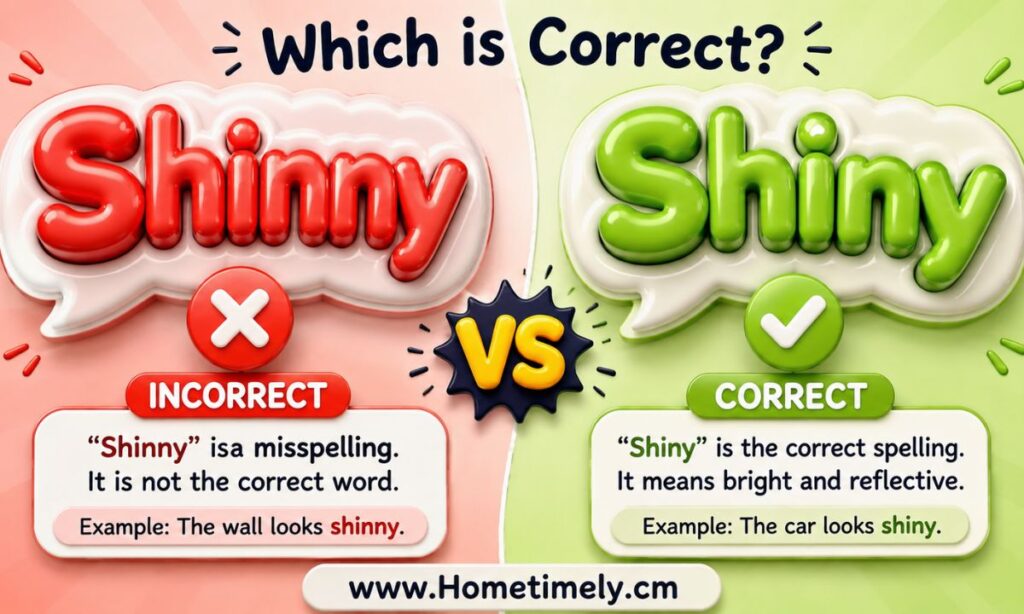
- Shiny = an adjective describing a smooth, reflective, or luminous surface. Her shoes were shiny.
- Shinny = a verb (to climb) or a noun (informal hockey). He shinnied up the pole. They played shinny on the pond.
- Shiney = a misspelling. Not found in any standard dictionary. Always wrong.
That is the entire difference in three lines. Everything else in this article is explanation, context, and practice.
Quick Comparison Table
| Word | Part of Speech | Meaning | Correct? |
| Shiny | Adjective | Reflecting light; glossy; bright | ✅ Yes |
| Shinny | Noun / Verb | Informal hockey game / to climb | ✅ Yes (in context) |
| Shiney | — | No standard meaning | ❌ No — misspelling |
| Shiniest | Adjective (superlative) | Most shiny | ✅ Yes |
| Shinnied | Verb (past tense) | Climbed using arms and legs | ✅ Yes |
Shiny: What It Means and How to Use It
Shiny is an adjective built from the Old English verb scinan — meaning “to shine” or “to emit light” — plus the common adjectival suffix -y. That suffix, also found in words like cloudy, muddy, and rainy, turns a root word into a describing word.
The result: shiny means something that reflects light, has a smooth glossy surface, or appears bright and polished. It is one of the most versatile descriptive words in everyday English.
Formal definition (Cambridge Dictionary): Shiny — adjective. (of a surface) reflecting light, typically because it is smooth or polished.
Shiny can describe virtually any surface — metal, skin, fabric, paper, flooring, hair, or even eyes. It can be used positively (“shiny new phone”) or neutrally (“shiny forehead” — less flattering). The key is that shiny is always about appearance, always about how light interacts with a surface.
Words Similar to Shiny (Upgrade Your Vocabulary)
When shiny starts to feel repetitive in your writing, these synonyms carry similar meaning with slightly different nuances:
- Glossy — shiny in an attractive, polished way; often used for printed materials or coated surfaces
- Lustrous — a softer, more elegant shine; common in descriptions of hair or fabric
- Gleaming — actively reflecting light, often suggesting cleanliness or newness
- Polished — shiny as a result of deliberate effort
- Glistening — shiny with moisture, like dew or sweat
- Sparkling — shiny with scattered light points, like glitter or diamonds
- Radiant — shiny and warm, often describing skin or light sources
- Burnished — shiny through rubbing or buffing, often for metal
Each word creates a slightly different image. Choosing the right one sharpens your writing considerably.
How to Use Shiny in a Sentence
- The freshly waxed floor looked shiny under the overhead lights.
- She always admired the shiny chrome handles on vintage motorcycles.
- His shoes were so shiny that you could see your own reflection in them.
- The packaging was printed on shiny paper that caught every glint of light.
- After a good polish, the old trophy looked as shiny as the day it was made.
- Small children are often distracted by shiny objects.
- The beetle’s wings had a deep, shiny green that looked almost metallic.
Shinny: What It Actually Means
This is where most people get surprised. Shinny is not a misspelling of shiny — it is a completely separate word with its own history, its own pronunciation quirks, and two distinct meanings. You will find it in both Merriam-Webster and the Cambridge Dictionary.
Shinny Meaning: Hockey
As a noun, shinny refers to an informal, unorganized game of ice hockey — the kind played on a frozen pond or backyard rink with no referees, no formal teams, no protective gear requirements, and no strict rule enforcement. Think of it as hockey the way it was meant to be played: for fun.
The game has deep roots in Canadian culture. Shinny predates organized ice hockey and is considered by many historians to be hockey’s direct ancestor. The name itself traces back to shinty, a Scottish stick-and-ball game brought to North America by immigrants in the 18th century. In the United States, the same activity is often called pond hockey or pick-up hockey, but in Canada, shinny is the word.
Shinny’s informal rules typically include:
- No formal referee or timekeeper
- No lifting the puck off the ice (for safety)
- No body checking
- Flexible, ever-changing team sizes
- Improvised equipment welcome — tree branches as sticks were common during the Great Depression
Shinny Meaning: Climbing
As a verb, shinny means to climb something by gripping it alternately with your arms and legs — the way a child shimmies up a tree or a rope in gym class. The motion is agile, quick, and uses the whole body.
The climbing sense likely comes from the Scots verb shin, meaning to scale something using the shins and legs as primary contact points.
- She shinnied up the flagpole to attach the banner.
- The boys shinnied down the drainpipe to escape the second floor.
- He shinnied up the rope faster than anyone else on the team.
Is Shinny a Real Word?
Absolutely. Shinny appears in Merriam-Webster, the Cambridge Dictionary, and the Oxford English Dictionary. It has two documented, accepted meanings — the informal hockey game and the climbing verb — and a legitimate etymological history going back to Scottish dialect. It is not a typo, not slang invented online, and not a regional oddity. It is a standard English word used correctly in specific contexts.
Which Spelling Is Correct?
Correct Spelling
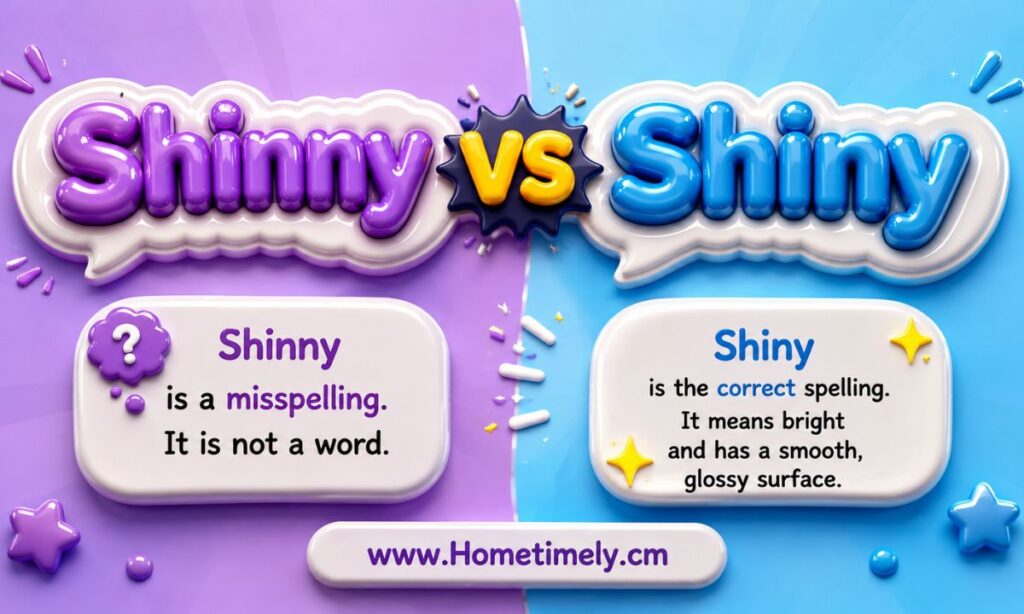
For describing something bright, reflective, or polished: the one and only correct spelling is shiny. Not shinny. Not shiney. S-H-I-N-Y.
Shiny is recognized by every major English dictionary worldwide. It is standard in British English, American English, Canadian English, and Australian English. No regional variation changes that.
Why “Shiney” Is Wrong
Shiney is a misspelling caused by a very understandable but incorrect assumption. Because the root word is shine — which ends in a silent e — many writers instinctively carry that e into the adjective: s-h-i-n-e-y. It feels logical.
But English spelling has a clear rule here: when a word ends in a silent “e,” you drop that “e” before adding a vowel suffix like -y.
| Root Word | Drop the “e” | Add “-y” | Result |
| shine | shin | + y | shiny ✅ |
| shade | shad | + y | shady ✅ |
| smoke | smok | + y | smoky ✅ |
| grease | greas | + y | greasy ✅ |
| lace | lac | + y | lacy ✅ |
Every one of those follows the same rule. Shiney breaks it — and no major dictionary has ever accepted it as standard.
Simple Rule
Drop the “e” from shine, add “y” → shiny. Every time. No exceptions.
If you remember nothing else from this article, remember that single rule.
Shinny vs Shiny Pronunciation: Why People Mix Them Up
Here is where the confusion gets its fuel. Say both words aloud:
- Shiny — pronounced SHAY-nee (IPA: /ˈʃʌɪni/)
- Shinny — pronounced SHIN-ee (IPA: /ˈʃɪni/)
They are close, but not identical. Shiny has a long “I” vowel in the first syllable (like the word shine). Shinny has a short “I” sound (like the word shin).
In casual, fast speech — especially in text messages, social media captions, and informal writing — that vowel difference blurs. People hear what sounds like “SHIN-ee” and write shinny when they mean shiny. Or they write shiney trying to spell what they hear and accidentally produce a non-word.
The fix: slow down and connect the word to its root. If you mean something that shines, write shiny. If you mean the hockey game or the climbing action, write shinny.
Common Mistakes — And How to Fix Them Fast
Using “Shinny” Instead of “Shiny”
This is the most frequent error. Someone means to describe something bright or polished but writes shinny instead. The result can be unintentionally comic.
❌ I love her shinny hair.
✅ I love her shiny hair.
❌ The table has a shinny finish after polishing.
✅ The table has a shiny finish after polishing.
❌ He drove a shinny new car.
✅ He drove a shiny new car.
Writing “Shiney”
Shiney never appears in any reputable dictionary. It is a misspelling 100% of the time. Spellcheck usually catches it — but not always, because in some contexts it may be confused with proper nouns or brand names.
❌ The ring was shiney and beautiful.
✅ The ring was shiny and beautiful.
❌ Shiney floors need regular maintenance.
✅ Shiny floors need regular maintenance.
Using Them Interchangeably
Shiny and shinny are not interchangeable. They belong to different grammatical categories with different meanings. Swapping them changes the meaning of the sentence entirely — sometimes in ways that make no sense.
❌ He shiny up the tree to rescue the cat.
✅ He shinnied up the tree to rescue the cat.
❌ The kids played shiny on the frozen pond.
✅ The kids played shinny on the frozen pond.
Quick Fix Strategy
When in doubt, ask yourself two questions:
- Am I describing how something looks? → Use shiny
- Am I talking about climbing or informal hockey? → Use shinny
- Did I add an “e” before the “y”? → Delete it. It is always shiny, never shiney
Shinny vs Shiny Examples That Make It Clear
Correct “Shiny” Usage
- The gemstone caught the sunlight and appeared brilliantly shiny.
- She polished the silverware until every piece was shiny and spotless.
- New cars always have that irresistible shiny showroom glow.
- The dancer’s costume was covered in shiny sequins that reflected the stage lights.
- After years of use, the brass doorknob had lost its shiny appearance.
Correct “Shinny” Usage
- Every winter, the neighborhood kids grabbed their sticks and played shinny on the frozen lake.
- He shinnied up the ladder-less pole to fix the antenna on the roof.
- Growing up in Manitoba, shinny was as much a part of winter as snowfall.
- The gymnast shinnied up the rope in under ten seconds.
- Before organized leagues existed, shinny was how most Canadians learned the game of hockey.
Side-by-Side Comparison
| Context | Wrong | Correct |
| Describing a polished surface | That’s a shinny countertop | That’s a shiny countertop |
| Describing informal hockey | Let’s play shiny on the pond | Let’s play shinny on the pond |
| Describing climbing | She shiny up the tree | She shinnied up the tree |
| Describing a new object | A shiney new bicycle | A shiny new bicycle |
| Describing hair appearance | Her hair is shinny | Her hair is shiny |
Shinny vs Shiny: What Real People Are Saying
If you search shinny vs shiny on Reddit, you will find hundreds of posts from people genuinely confused. The threads appear in communities like r/grammar, r/EnglishLearners, r/writing, and r/SpellingPolice.
The most common Reddit scenario: someone posts a product description or Instagram caption using shinny when they clearly meant shiny, and users pile in to correct it. Most posters are shocked to discover that shinny is a real word — just not the one they wanted.
A recurring insight from those threads: autocorrect is not reliable here. Because shinny is a dictionary word, many phone keyboards and word processors accept it without flagging it as wrong. That means the mistake goes through undetected. You cannot depend on technology to catch this one — you have to know the rule yourself.
Another common Reddit discussion involves people discovering shinny as a hockey term for the first time. Many American users are unfamiliar with the word in that context, since in the United States pond hockey or pick-up hockey is the more common phrase. For Canadian users, however, shinny is deeply familiar — part of the cultural vocabulary of winter.
Shinny vs Shiny in Pokémon GO: Why “Shiny” Matters More
If you play Pokémon GO, you have definitely seen the word shiny used in a very specific way. Here, shiny does not describe a shimmering surface — it refers to a rare game mechanic.
What Is Shiny in Pokémon GO?
According to the official Pokémon GO Help Center, Shiny Pokémon are rare variants of standard Pokémon that display a different color palette than normal. A Shiny Pikachu, for example, might appear in a golden-orange instead of its usual yellow. A shiny aura of stars appears around these Pokémon on the encounter screen to signal their special status.
Are Shiny Pokémon Rare?
Yes — significantly so. The standard Shiny encounter rate in Pokémon GO is approximately 1 in 512, compared to 1 in 4,096 in the main-series console games. However, rates vary:
- Legendary raid Pokémon: roughly 1 in 20
- Egg/raid exclusives: roughly 1 in 64
- Community Day featured Pokémon: roughly 1 in 25
Shiny Pokémon vs Normal Pokémon
| Feature | Normal Pokémon | Shiny Pokémon |
| Color | Standard game palette | Alternate rare palette |
| In-game indicator | None | Star aura icon above CP |
| Encounter rate | Appears normally | ~1 in 512 (standard) |
| Battle stats | Standard | Identical to normal |
| Desirability | Common | Highly collectible |
Common Confusion in Gaming Communities
In Pokémon GO forums and Discord servers, players sometimes write shinny Charizard or I got a shinny today — a misspelling that quickly gets corrected by other players. The Pokémon usage has nothing to do with the hockey or climbing meaning of shinny. In gaming, it is always shiny — the adjective describing something rare and special, echoing the original meaning of something bright and outstanding.
Why People Spell Shiny as Shinny
Understanding the psychology behind this mistake helps you avoid it permanently.
Main Reasons
- Phonetic confusion. Both words sound similar in casual speech. Fast talkers and fast typers blur the vowel distinction.
- The “shine” connection. People see shine → think shine + y → write shiney or accidentally double the “n” to produce shinny. Neither is correct when the intent is the adjective.
- Autocorrect interference. Some devices autocorrect shiny to shinny because both are valid dictionary entries. The software chooses the wrong word.
- Social media speed. Typing quickly on a phone leads to dropped or added letters. Shiny becomes shinny in seconds.
- No visual feedback. Because shinny is a real word, spellcheck does not flag it — giving false reassurance that the spelling is fine.
- The double-n pattern. Many adjectives with short vowel sounds do double their consonant (like funny, sunny, bunny). Writers mistakenly apply that pattern to shiny, producing shinny.
Shiny vs Glossy: A Subtle but Useful Distinction
Both words describe surfaces that reflect light, but they carry slightly different connotations. Knowing the difference makes your writing more precise.
Shiny is the broader, more general term. It covers any surface that reflects or emits light — from a polished shoe to a sweaty forehead. Shiny can be positive or neutral. It does not imply anything about the texture of the surface.
Glossy is more specific. It tends to describe surfaces that are both shiny and smooth in an attractive way. Glossy often appears in contexts like:
- Magazine printing (glossy magazine pages)
- Coated finishes (glossy paint, glossy photo paper)
- Lip products (lip gloss)
- Professional photography (glossy prints)
A useful way to think about it: glossy is always an attractive shiny. Shiny is not always glossy. A person’s oily forehead might be described as shiny but never glossy.
| Word | Connotation | Best Used For |
| Shiny | Neutral to positive | Any reflective surface |
| Glossy | Positive, attractive | Coated, polished, printed surfaces |
| Lustrous | Elegant, soft | Hair, fabric, pearls |
| Gleaming | Active, clean | Metal, clean surfaces, eyes |
Shine vs Shiny: Understanding the Connection
Shine and shiny come from the same root but function differently in a sentence — and confusing their roles leads to grammatical errors.
Shine is primarily a verb: The sun shines brightly. She polished the trophy to make it shine. It can also be a noun: Give those boots a shine before the interview.
Shiny is an adjective: The boots are shiny. She has shiny hair.
You cannot swap them grammatically:
❌ The floor is shine after cleaning.
✅ The floor is shiny after cleaning.
❌ She shiny up her presentation with new graphics.
✅ She shined up her presentation with new graphics.
The connection between them is straightforward: shiny describes something that shines. But each word occupies its own grammatical role and cannot step into the other’s place.
One Letter That Changes Everything
This section illustrates just how dramatically one letter shifts meaning — and how careful reading prevents embarrassing errors.
Version A
“The kids were excited. They grabbed their sticks and headed to the pond to play shiny all afternoon.”
Read that carefully. Did something feel off? It should have. Shiny is an adjective — it cannot function as the object of “play.” The sentence needs shinny, the noun meaning informal hockey.
✅ “…to play shinny all afternoon.”
Version B
“He bought a pair of leather shoes with a deep, shinny finish that caught everyone’s attention.”
Here, shinny is wrong because the writer is describing a surface appearance — that calls for the adjective shiny.
✅ “…with a deep, shiny finish…”
These two examples show why context is everything. The words look almost identical, but their jobs in a sentence are completely different.
How to Use Shinny in a Sentence (Correctly)
These examples use shinny in its two legitimate senses:
As a noun (informal hockey):
- Every December, the community center organized a shinny tournament for local kids.
- Growing up near a lake meant that weekend shinny games were a seasonal tradition.
- The old men gathered for an early-morning shinny session before work.
As a verb (to climb):
- She shinnied up the rope with surprising speed and grace.
- The firefighter shinnied down the ladder before the structure became unstable.
- As a child, he could shinny up any tree in the backyard within seconds.
How to Use Shiny in a Sentence (Daily Use)
These examples reflect the most common, everyday applications of shiny:
- The jewelry store window was full of shiny rings, necklaces, and bracelets.
- After the rain, the wet cobblestones looked unexpectedly shiny in the lamplight.
- She invested in a shiny new laptop for the school year.
- The mechanic returned the car with an engine that gleamed as shiny as new.
- His bald head was perfectly shiny under the studio lights — he owned it.
- Even the smallest shiny object could keep the toddler entertained for minutes.
Shiney or Shiny in UK English: Is There a Difference?
No. There is no regional spelling variation here. Shiny is the correct and only accepted spelling in British English, American English, Canadian English, and Australian English.
This is a question that appears regularly in forums and grammar communities because English does have regional spelling differences for many words (colour/color, organise/organize, grey/gray). But shiny is not one of them. The spelling is universal.
Shiney is not a British English variant. It is not an older or archaic form. It has never appeared in the Oxford English Dictionary as an accepted spelling. It is simply a spelling mistake regardless of where in the world you are writing.
Fill in the Blanks Practice: Shinny vs Shiny
Work through these exercises to lock in what you have learned.
Exercise 1: Choose the Correct Word
Fill each blank with either shiny or shinny:
- The kitchen tiles looked ________ after the deep clean.
- Every winter, the neighbourhood kids played ________ behind the school.
- She bought a ________ gold bracelet for her graduation gift.
- He ________ up the drainpipe to reach the stuck kite.
- A ________ new car sat in the dealership window, price tag gleaming.
- The hockey game was just a quick ________ — no rules, just fun.
Exercise 2: Fix the Mistakes
Each sentence below contains an error. Correct it:
- The dancer wore a beautiful shinny dress to the performance.
- They played shiny on the outdoor rink for two hours.
- After polishing, the brass lamp became completely shiney.
- He shiny up the rope faster than any other student in gym class.
- Her earrings were made of shiney silver and sparkled under the lights.
Exercise 3: Sentence Completion
Write a complete sentence for each prompt:
- Use shiny to describe a car after a car wash.
- Use shinny to describe children playing on ice.
- Use shiny to describe someone’s hair.
- Use shinny to describe climbing a tree.
- Use shiny in a sentence about a Pokémon GO encounter.
Also Read This : Tapping vs Taping: Difference and Correct Usage
Proofreading Tips That Actually Help
These strategies catch shinny/shiny/shiney errors before they go live:
- Read your draft aloud. Speaking the words forces your brain to process each one individually rather than scanning for general sense.
- Use Ctrl+F. Search for “shinny” in any document where you meant to describe something bright. If it appears as an adjective, replace it with “shiny.”
- Check the root word. Ask: does this word come from shine (the light verb)? If yes, write shiny. Does it refer to the climb or the hockey game? Write shinny.
- Never trust autocorrect alone. Both shiny and shinny pass spellcheck. You must know the rule yourself.
- Read backwards. Proofreaders sometimes read from the last sentence to the first. It forces you to evaluate each sentence on its own, removing the flow that can hide errors.
How to Stop Writing “Shiney”
The drop the e rule is one of the most reliable patterns in English adjective formation. Make it a habit:
- Shine → drop the “e” → shin → add “-y” → shiny
- Smoke → drop the “e” → smok → add “-y” → smoky
- Shade → drop the “e” → shad → add “-y” → shady
Every time you want to write “shiney,” remind yourself: the “e” gets dropped. It is never coming back. Write “shiny” and move on.
Memory trick: Think of the word sunshine — not sunshiney. The same logic applies. Shine → shiny.
Exercise 4: Quick Decision Challenge
For each item below, write shiny, shinny, or neither (if the sentence is fine as written):
- “The new phone case is absolutely _______.”
- “They organized a _______ game at the pond.”
- “She _______ up the climbing wall in record time.”
- “I want a _______ finish for the kitchen cabinets.”
- “The trophy was cleaned until it looked completely _______.”
Answer Key (Check Yourself)
Exercise 1 Answers:
- shiny
- shinny
- shiny
- shinnied
- shiny
- shinny
Exercise 2 Corrected Sentences:
- The dancer wore a beautiful shiny dress to the performance.
- They played shinny on the outdoor rink for two hours.
- After polishing, the brass lamp became completely shiny.
- He shinnied up the rope faster than any other student in gym class.
- Her earrings were made of shiny silver and sparkled under the lights.
Exercise 3 Sample Sentences:
- After the car wash, the vehicle looked shiny and brand new under the sun.
- The children spent the afternoon playing shinny on the frozen pond behind the school.
- Her hair was so shiny that it looked like it belonged in a shampoo commercial.
- He shinnied up the old oak tree to get a better view of the neighbourhood.
- She screamed with excitement when a shiny Eevee appeared in Pokémon GO.
Exercise 4 Answers:
- shiny
- shinny
- shinnied
- shiny
- shiny
Cambridge Dictionary Definitions for Reference
To settle any remaining doubt, here are the definitions directly attributed to Cambridge Dictionary:
Shiny (adjective): “Having a smooth, bright surface that reflects the light.” — Example: shiny black shoes; shiny hair
Shinny (verb): “To climb up or along something using both your arms and legs.” — Example: He shinnied up the pole.
Shinny (noun): Informal. “A game of ice hockey, especially one that is played informally.”
Neither shiney nor any alternative spelling of the adjective appears in the Cambridge Dictionary — because it is not a word.
Wrapping It All Up
Three words, three very different stories. Shiny is the adjective you reach for whenever something glows, reflects, or sparkles — the word on product labels, in Instagram captions, in literature, in science. Shinny is the word for frozen pond hockey and agile tree-climbing — specific, contextual, and genuinely useful in its place. And shiney? It has never been correct, and it never will be.
The rule is simple, the logic is clean, and now you have the practice to back it up. The next time your fingers hover over the keyboard and you are about to describe something bright and reflective, you already know: it is shiny. Drop the “e.” No exceptions. Done.

Michael Brook is the creator and author behind Healthy Leeks, a platform focused on grammar, writing skills, and English language learning. Passionate about clear communication and effective writing, Michael Brook shares practical grammar tips, easy-to-follow language guides, and educational content to help readers improve their English with confidence.


