If you have ever typed the word “presentor” and wondered whether it looked right, you are not alone. Thousands of people search this exact question every month — on Google, in grammar forums, and in professional writing communities. The confusion is completely understandable. English has enough inconsistencies to trip up even native speakers, and this particular word sits right at the crossroads of two competing spelling patterns.
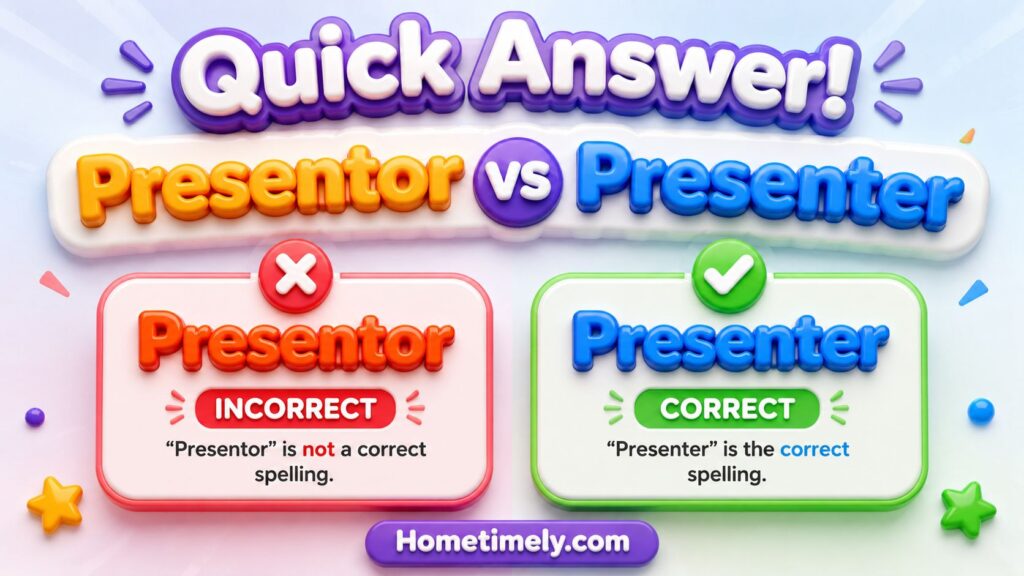
The short answer: presenter is correct. Presentor is not a recognized word in standard English.
But there is more to this story than a simple right-or-wrong verdict. Understanding why the confusion happens, how the word formed, and when you might encounter the wrong spelling will make the correct form stick in your memory for good. This guide covers all of it — clearly, practically, and with real-world examples.
Presentor vs Presenter: What’s the Difference?
At first glance, both spellings look plausible. Say either one aloud and they sound nearly identical. That phonetic similarity is a big part of why the mistake is so common. But when you look at how English constructs words — specifically how it builds agent nouns (words that describe a person who performs an action) — the correct choice becomes obvious.
Presenter is the standard, dictionary-recognized spelling. It is formed by combining the verb present with the suffix -er, which is the native English way of naming a person who does something.
Presentor is a non-standard variant. It is not listed in Merriam-Webster, Oxford, Cambridge, Collins, or any major English dictionary as a valid word. It appears occasionally as a typo, a phonetic misspelling, or a carryover from an older, Latin-influenced spelling pattern — but it has never been standardized in modern English.
Example:
| Usage | Correct? |
| She is the keynote presenter at the conference. | ✅ Yes |
| He is the best presenter on the news channel. | ✅ Yes |
| The award presenter took the stage. | ✅ Yes |
| She is the keynote presentor at the conference. | ❌ No |
| He is the best presentor on the news channel. | ❌ No |
There is no context — formal, informal, British, American, Canadian, or Australian — in which “presentor” becomes the preferred or accepted spelling. The correct form is always presenter.
Why Do People Confuse Presentor and Presenter?
This is not a random mistake. There is a very logical — if ultimately incorrect — chain of reasoning behind it. Once you understand the pattern, you will never make the mistake again.
Common Reasons:
1. The -or vs -er suffix problem
English borrows vocabulary from two major streams: Germanic/Old English and Latin/French. Each stream has its own way of forming agent nouns — words for people who do things.
- The Old English pattern uses -er: teacher, speaker, writer, runner, reader
- The Latin/French pattern uses -or: actor, senator, editor, creator, professor, director
Both suffixes are genuinely used in English today. That means when someone encounters the word present, their brain runs a quick pattern-match and might land on presentor because they are thinking of words like director, conductor, or instructor.
2. The word sounds like it could end in -or
When spoken quickly, “presenter” can sound like it ends in a softer vowel sound that could be transcribed as either -er or -or. People who are uncertain about the spelling sometimes write what they hear rather than applying grammatical rules.
3. Analogies to similar-sounding professions
Words like doctor, senator, investor, and contractor all end in -or and all describe professional roles. It feels natural to assume presentor belongs in the same group — especially since “presenting” is often a professional activity.
4. Inconsistency in English spelling rules
English learners are right to be frustrated here. The language genuinely does not follow a single consistent rule. The -er/-or divide is not always predictable. That makes it harder to intuit the correct form without looking it up or learning the specific word.
5. Seeing it online
Spelling errors spread online. When someone types “presentor” in a blog post, LinkedIn profile, or event flyer, others who see it may assume it is correct. Misspellings on the internet reinforce themselves over time, giving an incorrect form a false sense of legitimacy.
What Does “Presenter” Mean?

The word presenter has been part of the English language since at least the mid-15th century. According to the Oxford English Dictionary, the earliest recorded use of the noun presenter dates to around 1443, in the writing of Reginald Pecock, Bishop of Chichester. The meaning “host of a radio or television programme” is a more modern development, first appearing around 1967.
Etymologically, presenter traces back through Old French présenter and directly to the Latin praesentare, meaning “to place before” or “to show.” The -er suffix was attached following the standard English pattern for agent nouns derived from verbs, creating a word that means, simply, “one who presents.”
Today, the word is widely used across multiple fields and professional contexts.
Types of Presenters:
- TV presenter / news presenter — A person who hosts a television programme, introduces segments, or reads the news. In American English, the equivalent terms are often anchor, host, or newscaster.
- Conference presenter — A speaker at a professional or academic conference who delivers a prepared talk, shares research findings, or leads a session.
- Keynote presenter — The featured speaker at an event, typically delivering the most prominent address.
- Award presenter — Someone who formally announces and presents awards at a ceremony.
- Sales presenter — A professional who delivers product demonstrations or pitches to potential clients.
- Classroom presenter — A student or educator who presents material in an academic setting.
- Webinar presenter — A person who leads an online presentation or live-streamed educational session.
- Radio presenter — A host or DJ who presents programmes on radio, introducing content and speaking between segments.
Each of these uses refers to the same underlying concept: a person who stands before an audience — physical or virtual — and communicates information, entertainment, or ideas.
Synonyms for Presenter:
Depending on the context, a presenter might also be called:
- Host (especially for TV, podcasts, or events)
- Anchor or anchorperson (news broadcasting, common in American English)
- Compere (British English, especially for live events)
- Emcee / MC (master of ceremonies, informal events)
- Speaker (conferences, public talks)
- Announcer (radio, sports, ceremonies)
- Broadcaster (general media usage)
- Newsreader (British English, for those who read the news)
- Moderator (panels, debates, discussion-based events)
Using these synonyms in your writing not only adds variety but also demonstrates a strong grasp of professional vocabulary in communication and media contexts.
Also Read This : Useing or Using: Which Spelling Is Correct?
Is “Presentor” Ever Correct?
The direct answer is no. Presentor is not accepted in standard English and is not listed as a valid word in any major English dictionary — not Merriam-Webster, not Oxford, not Cambridge, not Collins. Spellcheckers in Microsoft Word, Google Docs, and Grammarly will flag it as an error.
There is a nuanced historical footnote worth mentioning: because the Latin root praesentare is a Latin-origin verb, early English writers influenced by Latin grammar occasionally formed the word as presentour or presentor in historical texts. This explains why the -or form has surfaced sporadically over the centuries. However, these uses are considered archaic, and the modern standardized form has always been presenter.
No style guide — not the Associated Press Stylebook, not the Chicago Manual of Style, not the Oxford Style Guide — recognizes presentor as a correct or acceptable alternative. Using it in professional writing, academic papers, resumes, or formal communications will be treated as a spelling mistake by editors and readers alike.
Important Tip:
If you are ever unsure about the spelling mid-sentence, ask yourself this: is the base form a verb? If yes, the agent noun almost always takes -er in English.
- Present → presenter ✅
- Speak → speaker ✅
- Teach → teacher ✅
- Write → writer ✅
Words that take -or are typically derived from Latin nouns or stems, not from common English verbs used in everyday speech. Actor, senator, auditor, and professor all come from purely Latin forms, not from modern English verb usage.
Presenter or Presentor: How to Remember the Right One
Spelling rules are most useful when they are easy to recall under pressure. Here are several memory strategies that work well for this particular word.
The verb rule: Ask yourself what verb the word comes from. Presenter comes from the verb present. English verbs that form agent nouns almost always use -er. If you can say “she presents,” the person who does it is a present-er.
The rhyme trick: Think of words you already know and spell correctly: speaker, teacher, reader, writer. They all end in -er. Presenter belongs to this family, not the actor/director family.
The profession test: When you write job titles or roles in professional documents — a resume, an event programme, a LinkedIn profile — you would write conference presenter, keynote presenter, news presenter. Never presentor. If you imagine typing it on a professional document, the correct form usually feels more natural once you have learned it.
The simple mantra: Present ends in a t. Add -er and you get presenter. No letters get dropped, no changes are made. It is one of the easier spelling formations in English.
Presenters or Presentors: What About Plural Forms?
The same logic applies perfectly to the plural. If presenter is the correct singular, then presenters is the correct plural. And presentors — the plural of a word that does not exist — is also incorrect.
You should never use presentors in any written context. It carries all the same problems as presentor, just multiplied by the number of people you are referring to.
Example:
| Sentence | Verdict |
| The presenters at the summit were highly engaging. | ✅ Correct |
| All presenters must submit their slides by Friday. | ✅ Correct |
| The event featured five presentors. | ❌ Incorrect |
| The presentors were asked to keep talks under 20 minutes. | ❌ Incorrect |
This applies regardless of how many presenters you are referring to — two, ten, or two hundred. The plural form is always presenters, formed by simply adding an -s to the already-correct singular presenter.
Common Mistakes to Avoid
Beyond the presenter/presentor confusion itself, there are a few related errors that tend to cluster around this word.
Mistake 1: Spelling it “presentor” in professional documents This is where the error causes the most damage. A resume listing you as a “conference presentor” or a speaker bio calling someone “the featured presentor” immediately signals a spelling error to any editor, hiring manager, or event organiser who reads it.
Mistake 2: Using “presentors” in plural contexts The incorrect plural compounds the problem. If the singular is wrong, the plural compounds it.
Mistake 3: Trusting unedited online sources Many websites, social media posts, and user-generated content contain spelling errors. The presence of “presentor” in a Google search autocomplete or on a forum post does not mean it is correct. Always verify against a reputable dictionary.
Mistake 4: Thinking British and American English differ here They do not. Unlike colour/color, organise/organize, or theatre/theater, the word presenter is spelled identically in all major varieties of English. There is no regional exception to fall back on.
Mistake 5: Confusing it with other -or words by analogy The words director, instructor, conductor, and narrator all end in -or and describe people who do professional activities. But these words have different etymological origins. Director comes from Latin director, narrator from Latin narrator. Presenter was formed in English from the English verb present, following the English -er pattern.
Pro Tip:
Whenever you write a word ending in -er or -or that describes a person, do a quick check against a dictionary app or spellchecker before publishing or submitting. Building this habit takes seconds and protects your credibility in every professional context.
Presenters or Presentors – Google Trends & Usage Data
Search volume data consistently confirms what the grammar books say. When comparing “presenter” against “presentor” across Google Search trends, the result is not even close. “Presenter” dominates global search volume and real-world usage in news articles, academic databases, and professional publications by an overwhelming margin.
Searches for “presentor” or “presentors” do appear — but they are almost entirely driven by people looking to confirm which spelling is correct, not by people who confidently believe the -or form is right. This is a meaningful distinction: search traffic around a misspelling tends to reflect correction-seeking rather than confident usage.
In published media — newspapers, academic journals, broadcast journalism — the word presentor is essentially absent from modern usage. Major style guides, news organisations, and content platforms universally recognize only presenter.
Tools like Grammarly and the built-in spelling checkers in Microsoft Word and Google Docs flag presentor as a misspelling immediately. This means that even when someone types it accidentally, the software itself pushes back.
Comparison Table: Presenter vs Presentor
| Feature | Presenter | Presentor |
| Correct spelling | ✅ Yes | ❌ No |
| In Merriam-Webster | ✅ Yes | ❌ No |
| In Oxford Dictionary | ✅ Yes | ❌ No |
| In Cambridge Dictionary | ✅ Yes | ❌ No |
| Used in AP Stylebook | ✅ Yes | ❌ No |
| Accepted in British English | ✅ Yes | ❌ No |
| Accepted in American English | ✅ Yes | ❌ No |
| Passes spellcheck (MS Word) | ✅ Yes | ❌ No |
| Used in professional documents | ✅ Yes | ❌ No |
| Historical variant (archaic) | No | Briefly, yes |
| Etymology | Latin via Old French + English -er suffix | Misspelling / archaic form |
| Plural form | Presenters ✅ | Presentors ❌ |
Quick Comparison
Still in doubt? Here is the simplest possible summary:
| Presenter | Presentor | |
| Correct? | Yes | No |
| In the dictionary? | Yes | No |
| Use in formal writing? | Always | Never |
| Use on a resume? | Yes | No |
| Passes spellcheck? | Yes | No |
The verdict: Use presenter. Always. In every context, every country, every industry, and every document type.
Final Thoughts
Language can be genuinely confusing, and the presenter/presentor debate is a perfect example of how logical reasoning can lead you to the wrong conclusion. English has two competing suffix systems — -er from Germanic roots and -or from Latin roots — and both appear in common professional words. It is entirely reasonable to wonder which one applies here.
But the answer has been settled for centuries: presenter, formed from the verb present following the native English -er pattern, is the one and only correct form. Presentor has no standing in any modern dictionary, style guide, or professional publication.
Whether you are writing a speaker introduction, filling out an event registration form, updating your resume, or publishing an article, the word you want is presenter. Now that you understand exactly why — through etymology, grammar rules, and a clear comparison of the evidence — it should be easy to get it right every single time.The rule is simple, the reason is clear, and the correct spelling is presenter. Write it with confidence.

Michael Brook is the creator and author behind Healthy Leeks, a platform focused on grammar, writing skills, and English language learning. Passionate about clear communication and effective writing, Michael Brook shares practical grammar tips, easy-to-follow language guides, and educational content to help readers improve their English with confidence.


